 Paint Color Lab
Chantilly Lace BM OC-65
Benjamin Moore Chantilly Lace (OC-65) has an LRV of 90.04 and a closest match in Behr Ultra Pure White (UPW).
- LRV
- 90.04light reflectance, 0–100
- Undertone
- Subtle greencalculated from Lab
- Hex
- #F4F6F1
- RGB
- 244, 246, 241
- CIE Lab
- 96.6 / -1.5 / 2.2D65, from hex
- Depth
- Light
Closest matches to Chantilly Lace in other brands
Ranked by CIEDE2000 colour difference (ΔE). Under 1 is near-identical; under 2 is hard to tell apart on a wall.
| Color | Brand | LRV | ΔE 2000 | How close |
|---|---|---|---|---|
| Ultra Pure White Behr UPW | Behr | 94 | 0.9 | near-identical |
| High Reflective White SW 7757 | Sherwin-Williams | 93 | 1.0 | very close |
| Delicate White PPG 1001-1 | PPG | 88 | 1.1 | very close |
| Ultra White Valspar 7006-24 | Valspar | 93.59 | 1.1 | very close |
| Whipped Cream Behr DC-001 | Behr | 91 | 1.4 | very close |
| Extra White SW 7006 | Sherwin-Williams | 86 | 1.5 | very close |
| Du Jour Valspar 7002-6 | Valspar | 86.04 | 2.3 | close, visible side by side |
| Commercial White PPG 1025-1 | PPG | 83 | 2.4 | close, visible side by side |
Matches come from the 190 colors in our database so far, not from every color each brand makes. Try the color matcher for any hex code.
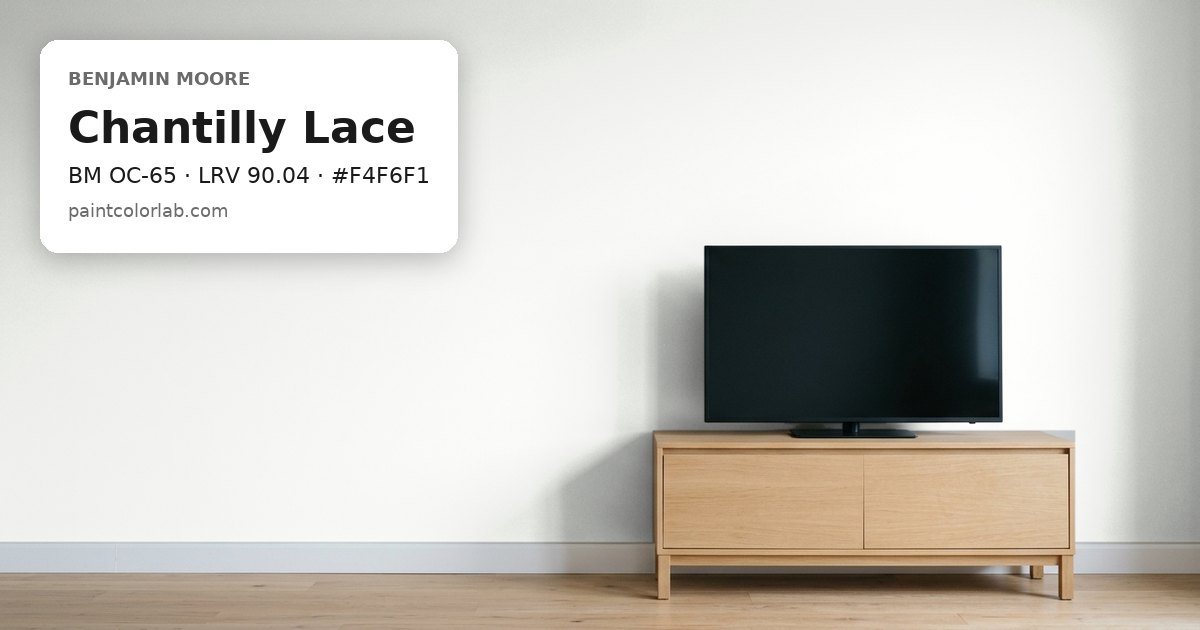
Chantilly Lace on a wall
About Chantilly Lace
Chantilly Lace LRV and undertone
Benjamin Moore Chantilly Lace (OC-65) has an LRV of 90.04, placing it near the bright end of the white color range. Light reflectance value measures how much visible light a paint color reflects, on a scale from 0 to 100. At this level, Chantilly Lace can help rooms appear brighter, although natural light, artificial lighting, and surrounding finishes also affect the result. Its light depth makes it suitable for walls, ceilings, and trim where a high-reflectance white is useful.
Its color family is white, with a subtle green undertone calculated from its Lab color values. An undertone is the underlying color that becomes more noticeable beside other whites or under particular lighting conditions. North-facing rooms often emphasize cooler or greenish shifts, while stronger southern light can change how those undertones appear. Test a sample beside flooring, cabinetry, and trim before committing to the full room.
Chantilly Lace in other brands
Several other brands offer close measured matches. Behr Ultra Pure White (UPW) has an LRV of 94.0 and a ΔE of 0.9. A ΔE below 1 indicates a near-identical color match. Sherwin-Williams High Reflective White (SW 7757) has an LRV of 93.0 and a ΔE of 1.0, making it a very close alternative. PPG Delicate White (PPG1001-1) has an LRV of 88.0 and a ΔE of 1.1. Valspar Ultra White (7006-24) also has a ΔE of 1.1, although its LRV of 93.59 indicates greater light reflectance.
Behr Whipped Cream (DC-001) measures ΔE 1.4, while Sherwin-Williams Extra White (SW 7006) measures ΔE 1.5. Both are very close matches by this metric. Remember that ΔE measures color difference, not differences in formulation, finish, or application behavior.
Lighter and darker Benjamin Moore alternatives
For a slightly darker option, Benjamin Moore Super White (OC-152) has an LRV of 87.36, followed by Benjamin Moore White Heron (OC-57) at 86.69. Both reflect less light than Chantilly Lace. Benjamin Moore Simply White (OC-117), with an LRV of 89.52, is also marginally darker. These options can help when a room needs a small reduction in reflectance rather than a major color change.
Benjamin Moore Decorator’s White (OC-149) has an LRV of 82.68, providing a more substantial step down. Lower-LRV whites can distinguish walls from brighter ceilings or trim. Compare dried samples under morning and evening lighting, and consider sheen because higher-gloss finishes can reflect light differently from matte surfaces.
Before you buy, compare a physical sample with the swatch on Benjamin Moore’s page for Chantilly Lace.
Similar Benjamin Moore colors
Comparisons
More in White paint colors.
Hex, RGB and LRV (LRV published; RGB read from the on-screen swatch) from Benjamin Moore's page for this color, checked October 24, 2026. Lab, undertone and ΔE are our calculations. Not affiliated with Benjamin Moore. See how we measure colors.