 Paint Color Lab
Chantilly Lace vs White Dove
Chantilly Lace (LRV 90.04) is lighter than White Dove (LRV 83.16), a difference of 6.88 LRV points; ΔE 2.6.
Side by side
| Chantilly Lace | White Dove | |
|---|---|---|
| LRV | 90.04 | 83.16 |
| Undertone | Subtle green | Warm (yellow) |
| Hex | #F4F6F1 | #EFEEE5 |
| Depth | Light | Light |
Color difference between them: ΔE 2000 = 2.6 (close, visible side by side).
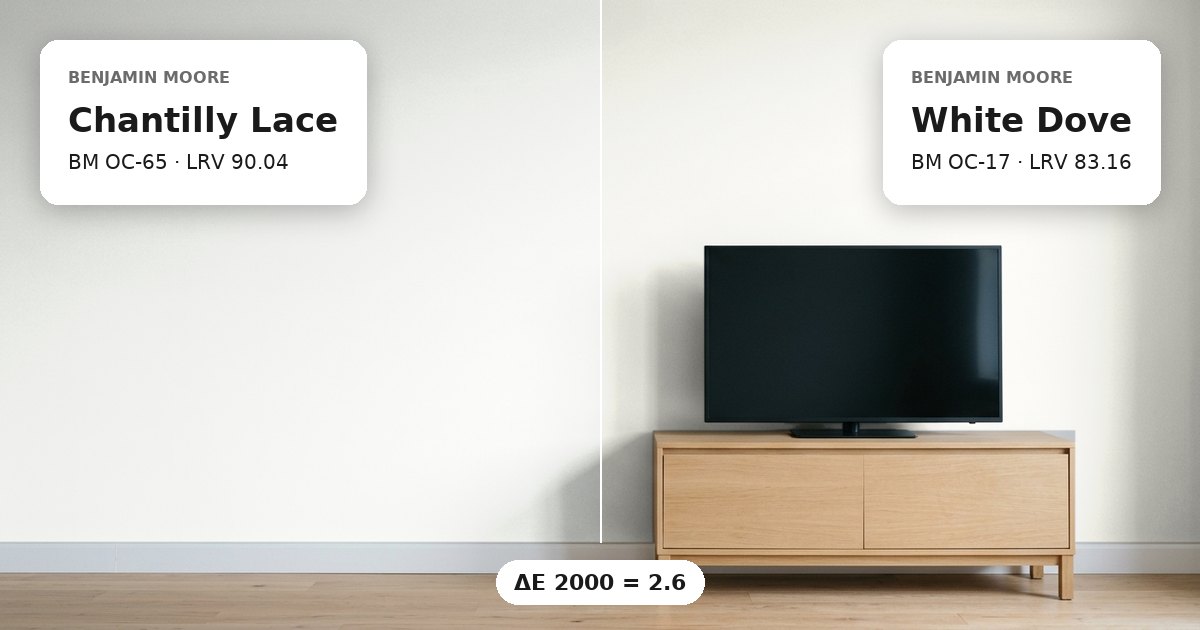
Chantilly Lace vs White Dove: the measured difference
Chantilly Lace vs White Dove compares two light whites with a ΔE 2000 of 2.6. A difference between 2 and 4 means the colors are close but visibly different when placed side by side. Benjamin Moore Chantilly Lace (OC-65) has a hex value of #F4F6F1, while Benjamin Moore White Dove (OC-17) has a hex value of #EFEEE5. Their listed undertones differ: Chantilly Lace has a subtle green undertone, while White Dove has a warm yellow undertone. This contrast in undertone direction helps explain why the pair may look more distinct than two whites with matching undertones. On adjoining walls, the difference may be noticeable, particularly when both surfaces receive similar light. However, the exact appearance depends on exposure and surrounding colors. Compare large samples together before deciding whether the contrast suits the transition between walls or connected rooms.
Lightness and depth
Chantilly Lace has an LRV of 90.04, while White Dove has an LRV of 83.16. The gap is 6.88 LRV points, with Chantilly Lace reflecting more visible light according to the supplied measurements. LRV indicates how much light a surface reflects, and higher values generally correspond to a lighter appearance. Both paints fall within the light category, but Chantilly Lace has the higher reading. As a result, it may appear brighter when the two colors are viewed together. The difference in LRV can contribute to a visible separation on adjoining walls, alongside their different undertones. Still, a room’s daylight and artificial lighting can influence the result. The higher LRV does not increase the amount of daylight entering the space. Test both shades under the same conditions to judge their relative brightness and how their undertones compare.
Undertones and where each works
Chantilly Lace has a subtle green undertone, while White Dove has warm yellow undertones. This difference matters when choosing colors for connected spaces, since the two whites may not appear equally warm. Cooler north-facing daylight can make green undertones more noticeable in some settings, while warmer south-facing light may emphasize yellow undertones. These are general lighting tendencies, and room finishes can change the effect. Chantilly Lace’s higher LRV may also help it appear lighter beside White Dove. For trim, consider which undertone you want to emphasize and whether you prefer a noticeable or restrained edge against the walls. If the colors meet at a doorway, sample them on opposite sides and inspect the transition from both rooms. Keep the trim finish in mind as well, because sheen changes how light reflects across painted surfaces. Evaluate the samples in daylight and after dark before settling on a combination.
Before you buy, compare a physical sample with the swatch on Benjamin Moore’s page for Chantilly Lace and Benjamin Moore’s page for White Dove.
Values from each brand's own color page; ΔE and undertone are our calculations. See methodology. Not affiliated with any paint brand.