 Paint Color Lab
Extra White SW 7006
Sherwin-Williams Extra White (SW 7006) has an LRV of 86 and closely matches Benjamin Moore Super White (OC-152), with ΔE 0.8.
- LRV
- 86light reflectance, 0–100
- Undertone
- Subtle greencalculated from Lab
- Hex
- #EEEFEA
- RGB
- 238, 239, 234
- CIE Lab
- 94.2 / -1.2 / 2.3D65, from hex
- Depth
- Light
Closest matches to Extra White in other brands
Ranked by CIEDE2000 colour difference (ΔE). Under 1 is near-identical; under 2 is hard to tell apart on a wall.
| Color | Brand | LRV | ΔE 2000 | How close |
|---|---|---|---|---|
| Super White BM OC-152 | Benjamin Moore | 87.36 | 0.8 | near-identical |
| Delicate White PPG 1001-1 | PPG | 88 | 0.8 | near-identical |
| White Heron BM OC-57 | Benjamin Moore | 86.69 | 1.0 | very close |
| Commercial White PPG 1025-1 | PPG | 83 | 1.1 | very close |
| Du Jour Valspar 7002-6 | Valspar | 86.04 | 1.5 | very close |
| Whipped Cream Behr DC-001 | Behr | 91 | 1.6 | very close |
| Swiss Coffee Valspar 7002-16 | Valspar | 86.15 | 1.8 | very close |
| Polar Bear Behr 75 | Behr | 90 | 1.9 | very close |
Matches come from the 190 colors in our database so far, not from every color each brand makes. Try the color matcher for any hex code.
Extra White on a wall
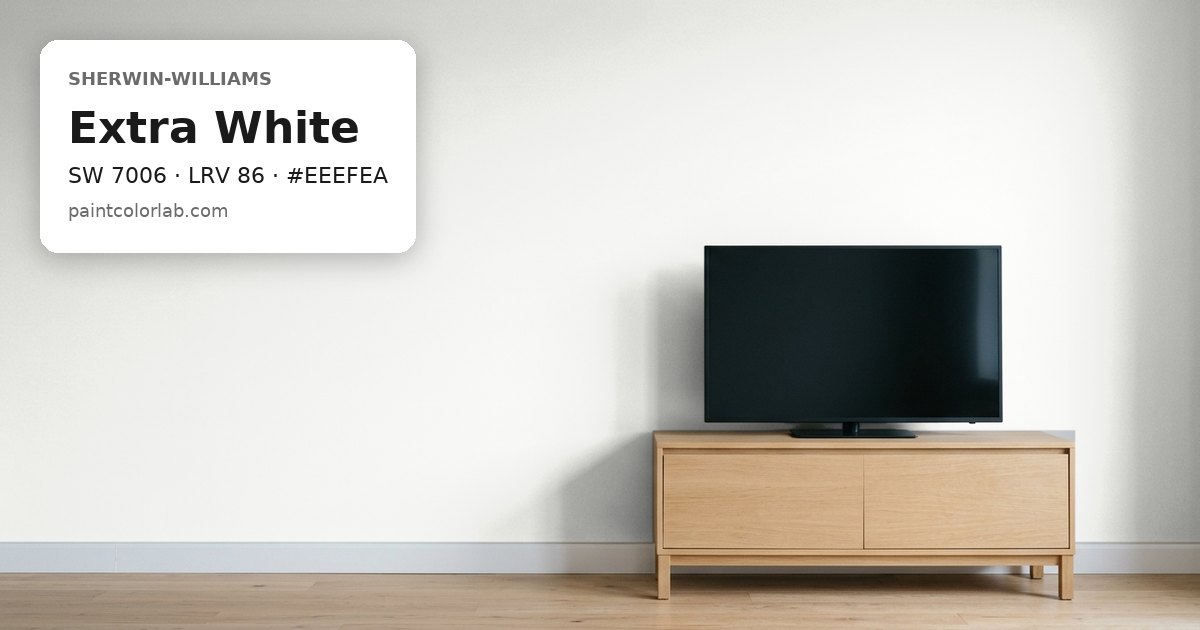
About Extra White
Extra White LRV and undertone
Sherwin-Williams Extra White (SW 7006) has an LRV of 86, placing it in the light range with high reflectance. Light Reflectance Value measures how much visible light a color reflects, on a scale from 0 to 100. With an LRV of 86, Extra White reflects much of the light that reaches the painted surface. Its color family is White, and its calculated undertone is subtle green. This undertone is not necessarily obvious in every room, but nearby warm whites or cream-colored finishes may make the difference easier to see.
Because daylight varies by orientation, evaluate the color in the room where you intend to use it. North-facing windows generally provide cooler light, while south-facing windows tend to receive warmer light. These conditions can change how subtle undertones appear. Place a sample beside your trim, flooring, and cabinetry, and inspect it at different times. A flatter finish typically reduces surface glare, while higher sheen can create more visible reflections. The sample should match the finish planned for the final application.
Extra White in other brands
Benjamin Moore Super White (OC-152) has an LRV of 87.36 and a ΔE of 0.8 relative to Extra White. A ΔE under 1 means the colors are near-identical in the supplied comparison. PPG Delicate White (PPG1001-1), at LRV 88, also has a ΔE of 0.8. Benjamin Moore White Heron (OC-57), with an LRV of 86.69, has a ΔE of 1.0, making it a very close match. PPG Commercial White (PPG1025-1), at LRV 83, has a ΔE of 1.1. These comparisons are very close, but samples remain useful because room lighting and finish influence appearance.
Lighter and darker Sherwin-Williams alternatives
Sherwin-Williams High Reflective White (SW 7757), at LRV 93, is lighter and reflects more light than Extra White. Sherwin-Williams Pure White (SW 7005), at LRV 84, is darker, with a ΔE of 1.1 indicating a very close color comparison. Sherwin-Williams Snowbound (SW 7004), at LRV 83, is darker as well and has a ΔE of 2.2, meaning the colors are close but visibly different side by side. Sherwin-Williams Ice Cube (SW 6252), at LRV 77, provides a larger reduction in reflectance. Consider High Reflective White when maximum light reflection is the priority, or a lower-LRV option when you want a less bright surface. Compare samples against the same trim and lighting conditions.
Before you buy, compare a physical sample with the swatch on Sherwin-Williams’s page for Extra White.
Similar Sherwin-Williams colors
Comparisons
More in White paint colors.
Hex, RGB and LRV (as published) from Sherwin-Williams's page for this color, checked October 24, 2026. Lab, undertone and ΔE are our calculations. Not affiliated with Sherwin-Williams. See how we measure colors.