 Paint Color Lab
Pure White vs Extra White
Pure White has an LRV of 84 versus 86 for Extra White, a 2-point difference; ΔE is 1.1.
Side by side
| Pure White | Extra White | |
|---|---|---|
| LRV | 84 | 86 |
| Undertone | Subtle warm (yellow) | Subtle green |
| Hex | #EDECE6 | #EEEFEA |
| Depth | Light | Light |
Color difference between them: ΔE 2000 = 1.1 (very close).
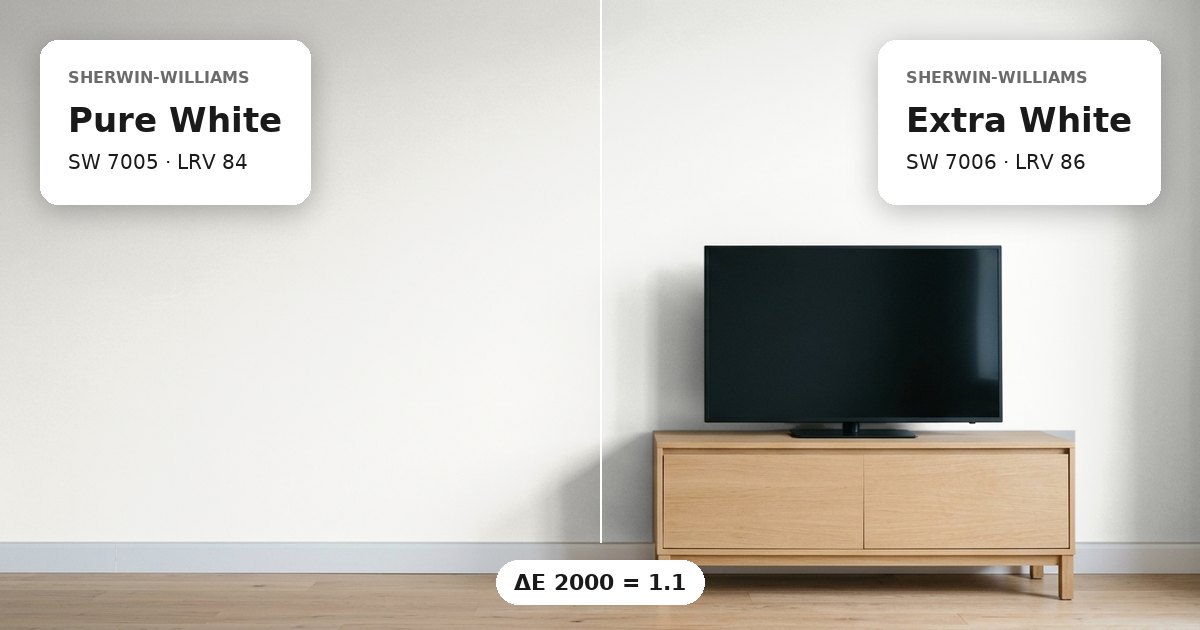
Pure White vs Extra White: the measured difference
Pure White vs Extra White have a measured color difference of ΔE 1.1, placing them in the very-close category. Their numerical color values are similar, but their undertones differ. Sherwin-Williams Pure White (SW 7005) has the hex value #EDECE6 and a subtle warm yellow undertone. Sherwin-Williams Extra White (SW 7006) is #EEEFEA and has a subtle green undertone. The distinction may be modest when the paints appear separately, yet it can become easier to notice when they meet on adjoining walls or when one serves as trim beside the other. Because both are light whites, the comparison depends heavily on the surrounding colors and lighting rather than on a large difference in overall depth.
Lightness and depth
Pure White has an LRV of 84, while Extra White has an LRV of 86. The two-point gap means Extra White reflects slightly more light and may appear marginally brighter under comparable conditions. Both LRVs place these paints firmly in the light category, making them suitable candidates when a high-reflectance white is needed. However, the LRV difference is small, so it should not be treated as a dramatic brightness change. Their undertones may be more useful for distinguishing them in a room. Surrounding wall colors, flooring, window exposure, and artificial lighting can all affect how each white reads. If the goal is to use one on walls and the other on trim, evaluate them together rather than relying on separate color cards.
Undertones and where each works
Pure White has a subtle warm yellow undertone, whereas Extra White has a subtle green undertone. These underlying differences can influence how each white relates to neighboring paint colors. Cooler north-facing daylight may make undertone differences more noticeable, while warmer south-facing light can shift the overall appearance of both whites. Pure White can be considered where a slightly warmer white is preferred; Extra White provides a slightly higher LRV and a different undertone direction. Either can be used for trim or walls, but the intended combination matters. Against a warm greige, a green-leaning white may produce a different contrast from a yellow-leaning white. Before committing, paint sample boards and move them beside the wall color, flooring, and cabinetry. Check them during daylight and after switching on the room’s regular lights, because two similar whites can respond differently to their surroundings.
Before you buy, compare a physical sample with the swatch on Sherwin-Williams’s page for Pure White and Sherwin-Williams’s page for Extra White.
Values from each brand's own color page; ΔE and undertone are our calculations. See methodology. Not affiliated with any paint brand.