 Paint Color Lab
Ultra White Valspar 7006-24
Valspar Ultra White (7006-24) has an LRV of 93.59 and is nearly identical to Sherwin-Williams High Reflective White (SW 7757).
- LRV
- 93.59light reflectance, 0–100
- Undertone
- Subtle warm (yellow)calculated from Lab
- Hex
- #F8F8F3
- RGB
- 248, 248, 243
- CIE Lab
- 97.5 / -0.9 / 2.4D65, from hex
- Depth
- Light
Closest matches to Ultra White in other brands
Ranked by CIEDE2000 colour difference (ΔE). Under 1 is near-identical; under 2 is hard to tell apart on a wall.
| Color | Brand | LRV | ΔE 2000 | How close |
|---|---|---|---|---|
| High Reflective White SW 7757 | Sherwin-Williams | 93 | 0.5 | near-identical |
| Ultra Pure White Behr UPW | Behr | 94 | 0.8 | near-identical |
| Whipped Cream Behr DC-001 | Behr | 91 | 0.8 | near-identical |
| Chantilly Lace BM OC-65 | Benjamin Moore | 90.04 | 1.1 | very close |
| Super White BM OC-152 | Benjamin Moore | 87.36 | 1.4 | very close |
| Delicate White PPG 1001-1 | PPG | 88 | 1.4 | very close |
| Extra White SW 7006 | Sherwin-Williams | 86 | 2.0 | very close |
| Commercial White PPG 1025-1 | PPG | 83 | 2.5 | close, visible side by side |
Matches come from the 190 colors in our database so far, not from every color each brand makes. Try the color matcher for any hex code.
Ultra White on a wall
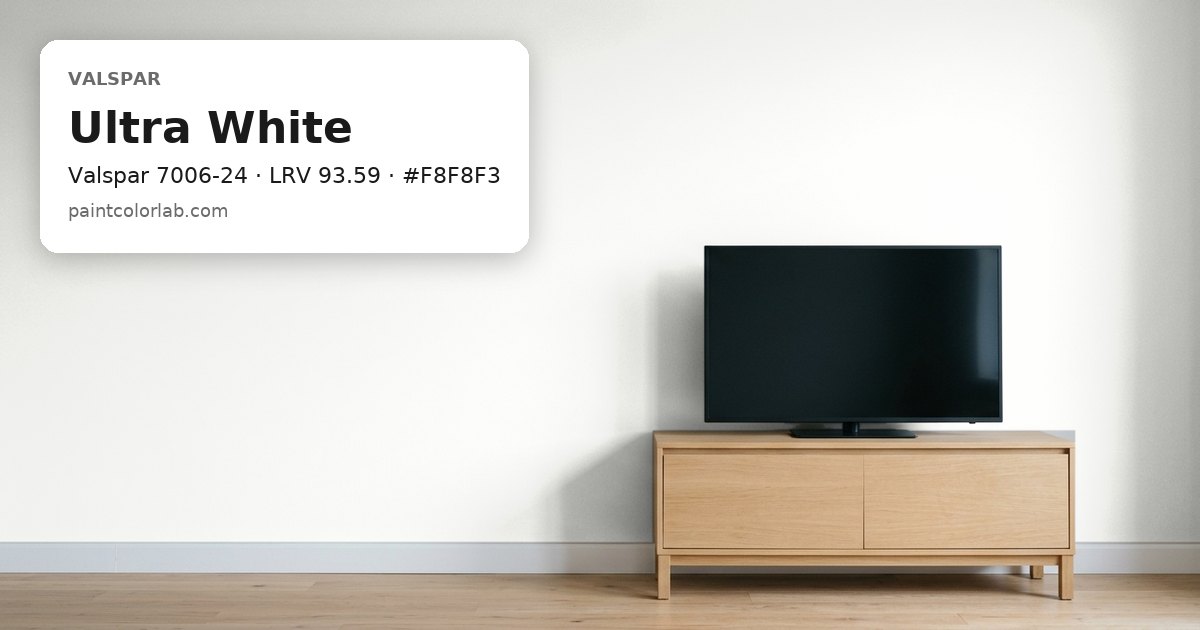
About Ultra White
Valspar Ultra White (7006-24) LRV and undertone
Valspar Ultra White (7006-24) has an LRV of 93.59, placing it near the brightest end of the white color range. Light reflectance value measures how much visible light a painted surface reflects. At this level, the finish can help a room feel brighter and can support spaces with limited natural light. Ultra White belongs to the white color family and has a subtle warm, yellow undertone calculated from its Lab values. Although the surface reads as white, that undertone can become more noticeable beside cooler whites or under certain lighting conditions.
For walls, ceilings, or trim, consider how surrounding finishes affect the comparison. North-facing rooms generally receive cooler daylight, while south-facing rooms receive warmer, more direct light. Therefore, the perceived warmth may vary throughout the day. Test a sample beside your flooring and trim before choosing a whole-room finish.
Valspar Ultra White (7006-24) in other brands
The closest listed alternatives include Sherwin-Williams High Reflective White (SW 7757), with an LRV of 93.0 and ΔE 0.5, and Behr Ultra Pure White (UPW), with an LRV of 94.0 and ΔE 0.8. Both are near-identical by the supplied ΔE 2000 measurements. Behr Whipped Cream (DC-001) also has ΔE 0.8, making it near-identical by this measure despite its lower LRV of 91.0.
Benjamin Moore Chantilly Lace (OC-65) has ΔE 1.1, so it is very close. Benjamin Moore Super White (OC-152) and PPG Delicate White (PPG1001-1) each have ΔE 1.4 and are also very close. These measurements describe overall color difference, not identical behavior under every light source.
Lighter and darker Valspar alternatives
All four listed same-brand alternatives are darker by LRV. Valspar Du Jour (7002-6), at 86.04, is the closest listed option by ΔE at 2.0 and reflects less light. Valspar Swiss Coffee (7002-16), at 86.15, has ΔE 2.4. Valspar Dove White (7002-7), at 85.13, has ΔE 3.6, while Valspar Summer Gray (7006-17), at 80.27, has ΔE 3.7.
Choose a lower-LRV alternative when you want less reflected light or more separation from brighter white trim. Du Jour and Swiss Coffee offer relatively small LRV reductions, while Summer Gray creates a larger brightness difference. Compare samples in the intended sheen because sheen can affect perceived brightness and contrast.
Before you buy, compare a physical sample with the swatch on Valspar’s page for Ultra White.
Similar Valspar colors
More in White paint colors.
Hex, RGB and LRV (as published) from Valspar's page for this color, checked October 24, 2026. Lab, undertone and ΔE are our calculations. Not affiliated with Valspar. See how we measure colors.