 Paint Color Lab
Simply White BM OC-117
Benjamin Moore Simply White (OC-117) has an LRV of 89.52 and a warm yellow undertone. Closest match: Behr Polar Bear (75).
- LRV
- 89.52light reflectance, 0–100
- Undertone
- Warm (yellow)calculated from Lab
- Hex
- #F6F6ED
- RGB
- 246, 246, 237
- CIE Lab
- 96.7 / -1.6 / 4.3D65, from hex
- Depth
- Light
Closest matches to Simply White in other brands
Ranked by CIEDE2000 colour difference (ΔE). Under 1 is near-identical; under 2 is hard to tell apart on a wall.
| Color | Brand | LRV | ΔE 2000 | How close |
|---|---|---|---|---|
| Polar Bear Behr 75 | Behr | 90 | 0.8 | near-identical |
| High Reflective White SW 7757 | Sherwin-Williams | 93 | 1.4 | very close |
| Ultra Pure White Behr UPW | Behr | 94 | 1.5 | very close |
| Swiss Coffee Valspar 7002-16 | Valspar | 86.15 | 1.8 | very close |
| Ultra White Valspar 7006-24 | Valspar | 93.59 | 1.9 | very close |
| Extra White SW 7006 | Sherwin-Williams | 86 | 2.3 | close, visible side by side |
| Delicate White PPG 1001-1 | PPG | 88 | 2.4 | close, visible side by side |
| Commercial White PPG 1025-1 | PPG | 83 | 2.5 | close, visible side by side |
Matches come from the 190 colors in our database so far, not from every color each brand makes. Try the color matcher for any hex code.
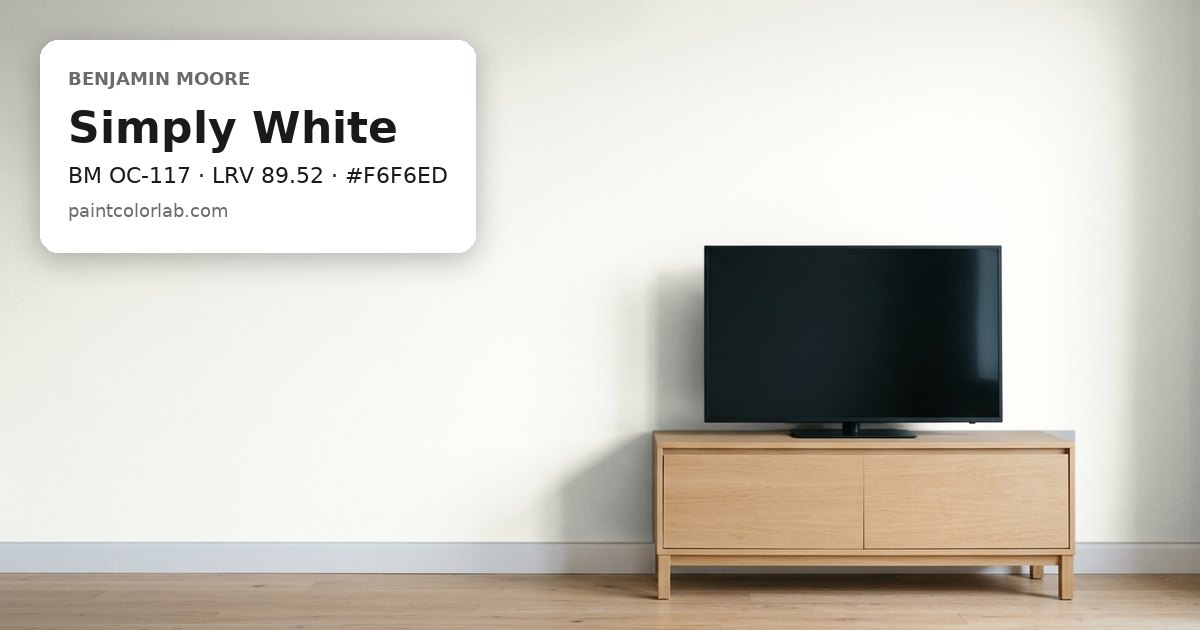
Simply White on a wall
About Simply White
Simply White (OC-117) LRV and undertone
Benjamin Moore Simply White (OC-117) has an LRV of 89.52, a light depth, and a white color family with a warm yellow undertone. Light Reflectance Value measures the percentage of visible light a color reflects. An LRV close to 90 indicates high reflectance, so Simply White can help walls and ceilings appear bright. Its warm undertone may become more noticeable beside cooler whites or in lighting that emphasizes yellow. North-facing rooms can make cool contrasts more apparent, while southern light often strengthens warmth. The room’s flooring, trim, and furnishings also influence how the paint reads. Test a sample in the actual space rather than relying on a small printed chip.
Simply White in other brands
Behr Polar Bear (75) has an LRV of 90.0 and a ΔE of 0.8, making it a near-identical measured match. Sherwin-Williams High Reflective White (SW 7757), with an LRV of 93.0 and ΔE of 1.4, is very close but reflects more light. Behr Ultra Pure White (UPW) has an LRV of 94.0 and ΔE of 1.5, also qualifying as very close while offering higher reflectance. Valspar Swiss Coffee (7002-16), at LRV 86.15 and ΔE 1.8, provides another very close alternative with lower reflectance. ΔE expresses the measured difference between colors. Under 1 means near-identical; 1–2 means very close; 2–4 means close but visibly different side by side; above 4 means only similar. A low ΔE does not guarantee that two paints will look identical under every light source or finish.
Lighter and darker Benjamin Moore alternatives
Benjamin Moore Chantilly Lace (OC-65) has an LRV of 90.04 and a ΔE of 1.9, making it slightly lighter by reflectance and very close in measured color. It can be worth comparing where maximum brightness matters. Benjamin Moore White Heron (OC-57), with an LRV of 86.69 and ΔE of 1.4, is a darker alternative that remains very close. Benjamin Moore Cloud White (OC-130) has an LRV of 85.05 and a ΔE of 1.4, so it reflects less light while retaining a similar measured color. Benjamin Moore White Dove (OC-17), at LRV 83.16, offers another darker option. For crisp contrast, compare each sample with the intended trim; for a subtler transition, choose neighboring lightness levels. Observe the samples in morning and evening light before selecting a final wall color.
Before you buy, compare a physical sample with the swatch on Benjamin Moore’s page for Simply White.
Similar Benjamin Moore colors
Comparisons
More in White paint colors.
Hex, RGB and LRV (LRV published; RGB read from the on-screen swatch) from Benjamin Moore's page for this color, checked October 24, 2026. Lab, undertone and ΔE are our calculations. Not affiliated with Benjamin Moore. See how we measure colors.