 Paint Color Lab
Simply White vs Chantilly Lace
Simply White has an LRV of 89.52 versus 90.04 for Chantilly Lace, a 0.52-point difference; ΔE is 1.9.
Side by side
| Simply White | Chantilly Lace | |
|---|---|---|
| LRV | 89.52 | 90.04 |
| Undertone | Warm (yellow) | Subtle green |
| Hex | #F6F6ED | #F4F6F1 |
| Depth | Light | Light |
Color difference between them: ΔE 2000 = 1.9 (very close).
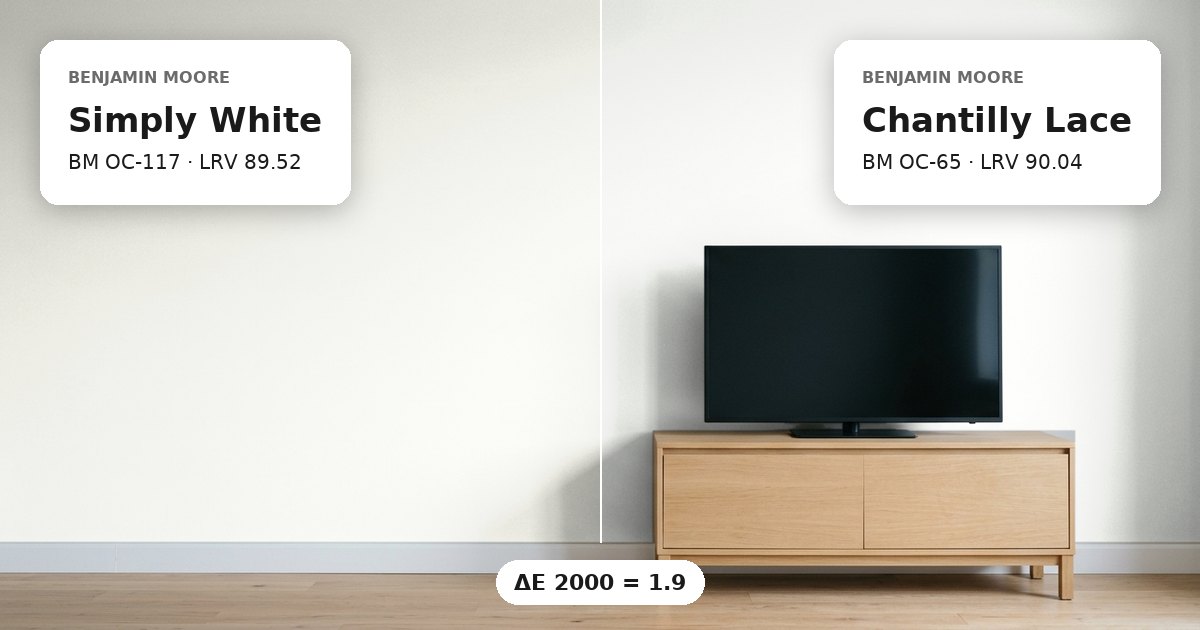
Simply White vs Chantilly Lace: the measured difference
Simply White vs Chantilly Lace have a ΔE 2000 of 1.9, which places them in the very close range. Their difference is subtle, but it can still be visible when the colors appear together on adjoining walls, trim, or cabinetry. Benjamin Moore Simply White has a warm yellow undertone, while Benjamin Moore Chantilly Lace has a subtle green undertone. This distinction matters because two whites with nearly identical lightness can look different beside the same flooring or furnishings. Simply White’s warmer undertone may read differently from Chantilly Lace’s subtle green influence, depending on the light and surrounding finishes. Neither color should be assumed to match the other exactly simply because both are high-LRV whites.
Lightness and depth
Benjamin Moore Simply White (OC-117) has an LRV of 89.52, while Benjamin Moore Chantilly Lace (OC-65) has an LRV of 90.04. Their difference is just 0.52 LRV points. Both reflect a high proportion of visible light, so they generally appear bright under comparable lighting conditions. Chantilly Lace has the slightly higher LRV, but this small numerical gap does not guarantee an obvious brightness difference in a finished room. Instead, undertones may contribute more to the perceived distinction than their reflectance values. Wall size, natural light, and nearby colors can all affect how these whites appear. Consider the LRV figures alongside undertones rather than using them as the only basis for selection.
Undertones and where each works
Simply White’s warm yellow undertone distinguishes it from Chantilly Lace’s subtle green undertone. Cooler north-facing daylight can affect how either undertone reads, while warmer south-facing daylight may emphasize the yellow component of Simply White. The exact result depends on the room’s exposure, surrounding materials, and artificial lighting. For a consistent finish across several spaces, check each white in the rooms where it will be used rather than assuming the same appearance everywhere.
Either color can be considered for walls or trim when a bright white is needed, but test the pair together before assigning separate roles. A slight undertone difference may be more apparent when one white frames another. If using one for walls and the other for trim, view the samples vertically and under the room’s actual lighting. Also compare them against flooring and fixed finishes. A sample board makes it easier to judge whether their subtle difference supports the intended transition between adjoining rooms.
Before you buy, compare a physical sample with the swatch on Benjamin Moore’s page for Simply White and Benjamin Moore’s page for Chantilly Lace.
Values from each brand's own color page; ΔE and undertone are our calculations. See methodology. Not affiliated with any paint brand.