 Paint Color Lab
White Dove vs Simply White
White Dove has an LRV of 83.16 and Simply White 89.52, a 6.36-point difference; ΔE 1.7 means they are very close.
Side by side
| White Dove | Simply White | |
|---|---|---|
| LRV | 83.16 | 89.52 |
| Undertone | Warm (yellow) | Warm (yellow) |
| Hex | #EFEEE5 | #F6F6ED |
| Depth | Light | Light |
Color difference between them: ΔE 2000 = 1.7 (very close).
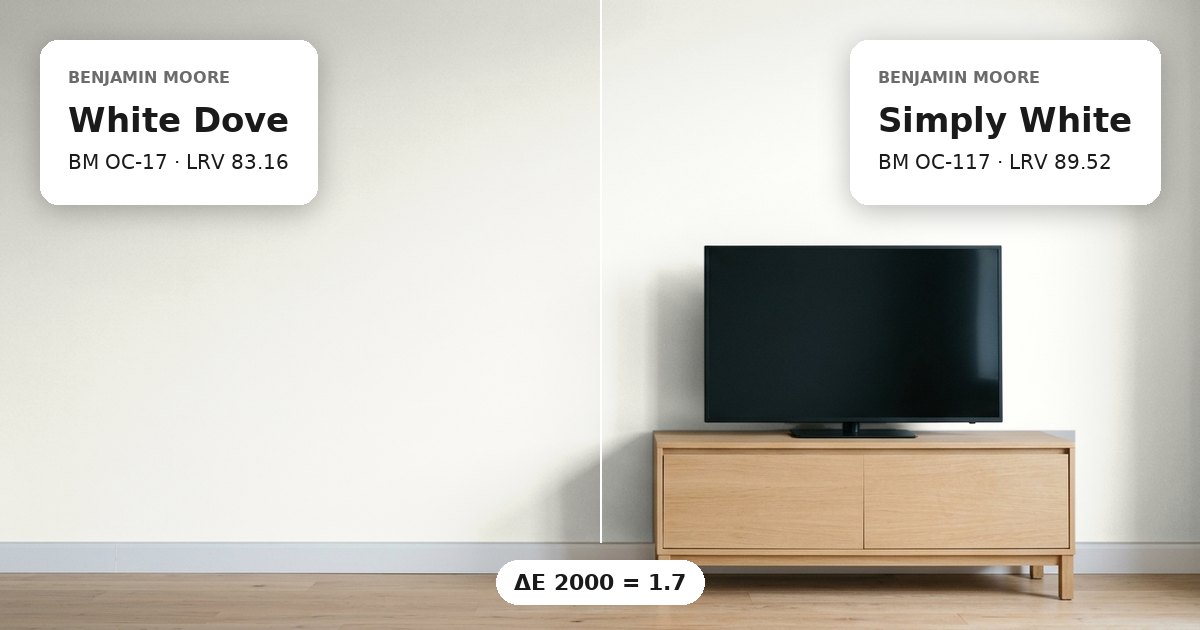
White Dove vs Simply White: the measured difference
White Dove vs Simply White compares two warm whites with a ΔE 2000 of 1.7. A difference between 1 and 2 indicates a very close match, although the colors may look different when placed side by side. Benjamin Moore White Dove (OC-17) has a hex value of #EFEEE5, while Benjamin Moore Simply White (OC-117) has a hex value of #F6F6ED. Both are classified as light whites and have warm yellow undertones. However, their measured colors are not identical, and Simply White has the higher LRV. On adjoining walls, the difference may be visible under suitable lighting without creating a strong contrast. The hex values also show that the colors differ in their recorded lightness and channel values. Since lighting and nearby finishes influence perceived color, compare samples in the intended room before deciding whether the distinction is sufficient for your design.
Lightness and depth
White Dove has an LRV of 83.16, while Simply White has an LRV of 89.52. The gap is 6.36 LRV points, giving Simply White the higher measured light reflectance. LRV indicates the proportion of visible light reflected by a surface, so a higher value generally corresponds to a brighter-looking paint color. Both shades remain in the light category, but their difference is larger than the LRV gap in several close-white comparisons. Consequently, Simply White may read lighter on the wall, especially when both samples are viewed together. This does not mean the room will receive more daylight; LRV describes the painted surface, not the amount of light entering through windows. Room exposure, artificial lighting, and surrounding finishes still affect the final appearance. Test the two colors in the same location to assess their relative brightness accurately.
Undertones and where each works
Both White Dove and Simply White have warm yellow undertones. That shared undertone can help them relate to one another across connected rooms, while their lightness difference provides some visual distinction. Cooler north-facing daylight may reduce the apparent warmth of a white, whereas warmer south-facing daylight can emphasize yellow undertones. These effects vary with the room and its finishes. White Dove may suit a wall scheme where slightly less measured reflectance is desired, while Simply White offers the higher LRV. These are comparisons based on the supplied measurements, not guarantees of appearance. When pairing either color with trim, check whether the trim creates enough contrast in the actual lighting. For adjoining rooms, sample both shades near the doorway and view them from each side. A consistent sheen can help make the comparison easier, while differences in sheen may affect how light reflects from the surfaces.
Before you buy, compare a physical sample with the swatch on Benjamin Moore’s page for White Dove and Benjamin Moore’s page for Simply White.
Values from each brand's own color page; ΔE and undertone are our calculations. See methodology. Not affiliated with any paint brand.