 Paint Color Lab
Pale Oak BM OC-20
Benjamin Moore Pale Oak (OC-20) has an LRV of 68.64 and a warm yellow undertone. Closest match: Behr Campfire Ash (N320-1).
- LRV
- 68.64light reflectance, 0–100
- Undertone
- Warm (yellow)calculated from Lab
- Hex
- #DDD9CE
- RGB
- 221, 217, 206
- CIE Lab
- 86.7 / -0.5 / 5.9D65, from hex
- Depth
- Light
Closest matches to Pale Oak in other brands
Ranked by CIEDE2000 colour difference (ΔE). Under 1 is near-identical; under 2 is hard to tell apart on a wall.
| Color | Brand | LRV | ΔE 2000 | How close |
|---|---|---|---|---|
| Campfire Ash Behr N320-1 | Behr | 69 | 0.0 | near-identical |
| Silver Drop Behr 790C-2 | Behr | 70 | 0.5 | near-identical |
| Oyster White SW 7637 | Sherwin-Williams | 72 | 1.3 | very close |
| Drift of Mist SW 9166 | Sherwin-Williams | 69 | 1.4 | very close |
| Gilded Linen Valspar 6002-1A | Valspar | 73.84 | 1.5 | very close |
| Hourglass PPG 1022-1 | PPG | 75 | 1.7 | very close |
| Antique White PPG 1024-2 | PPG | 72 | 2.2 | close, visible side by side |
| Tempered Gray Valspar 4004-1A | Valspar | 64.93 | 2.3 | close, visible side by side |
Matches come from the 190 colors in our database so far, not from every color each brand makes. Try the color matcher for any hex code.
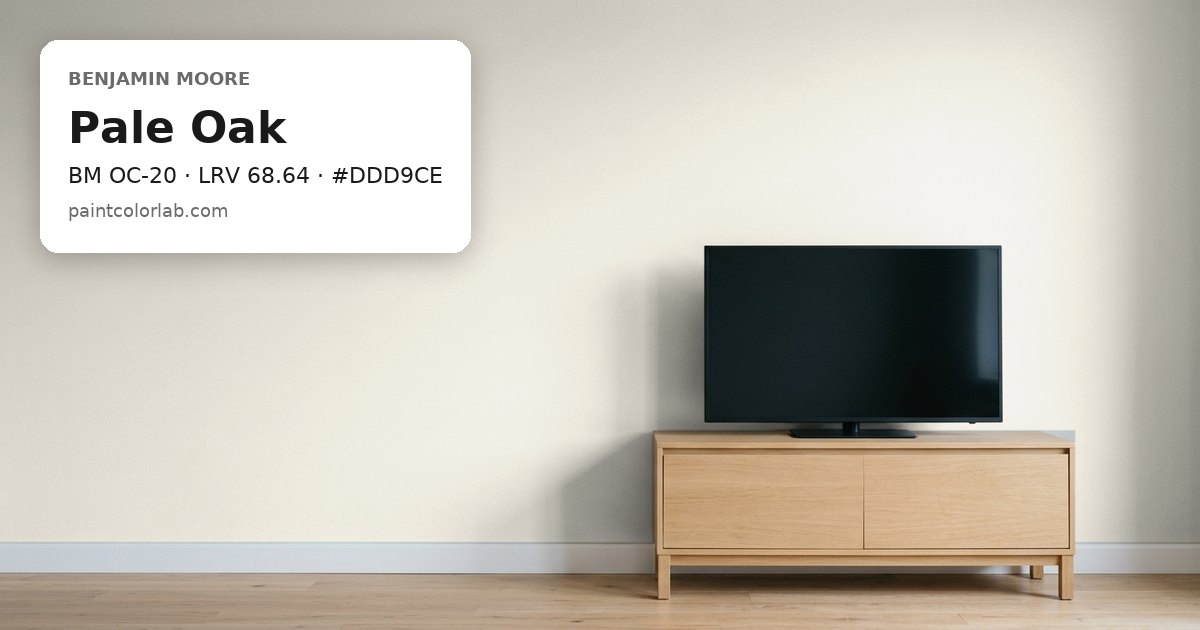
Pale Oak on a wall
About Pale Oak
Pale Oak LRV and undertone
Benjamin Moore Pale Oak (OC-20) has an LRV of 68.64, placing it in the light depth range. Its greige color family combines characteristics associated with gray and beige, while its calculated undertone is warm yellow. Light reflectance value (LRV) measures how much visible light a painted surface reflects. At this level, Pale Oak can help maintain brightness in a room without approaching the reflectance of a near-white paint. Its warm undertone may appear more noticeable under lighting that emphasizes yellow, while cooler light can change the balance of its appearance. North-facing rooms often receive cooler daylight, whereas south-facing rooms typically receive warmer, more direct daylight. Test a sample on different walls before committing to the color, especially when existing flooring and trim have distinct undertones.
Pale Oak in other brands
Several paints offer close measured matches across other manufacturers. Behr Campfire Ash (N320-1), with an LRV of 69.0 and ΔE of 0.0, is the closest listed match. A ΔE below 1 indicates a near-identical measured color, although paint formulas and finishes can still affect the final appearance. Behr Silver Drop (790C-2), at ΔE 0.5, is also near-identical. Sherwin-Williams Oyster White (SW 7637), at ΔE 1.3, is very close, as is Sherwin-Williams Drift of Mist (SW 9166), also at ΔE 1.4. Valspar Gilded Linen (6002-1A), with an LRV of 73.84 and ΔE 1.4, provides another very close option. These comparisons use CIEDE2000 color difference values, not guarantees of identical results on a wall.
Lighter and darker Benjamin Moore alternatives
For a slightly lighter option, Benjamin Moore Classic Gray (OC-23) has an LRV of 73.67 and a ΔE of 1.8. Its higher reflectance may suit rooms where additional brightness is the priority. Benjamin Moore Light Pewter (1464), with an LRV of 67.52 and ΔE 0.6, is slightly darker by LRV and nearly identical by measured color difference. Benjamin Moore Balboa Mist (OC-27), at LRV 65.53 and ΔE 0.8, offers a more substantial reduction in reflectance while remaining a very close match. Benjamin Moore Edgecomb Gray (HC-173), with an LRV of 63.09 and ΔE 2.2, is darker and visibly more distinct beside Pale Oak. Choose among these alternatives based on desired brightness and adjacent finishes. Compare dried samples under the room’s actual lighting, and consider using different sheens when trim contrast matters.
Before you buy, compare a physical sample with the swatch on Benjamin Moore’s page for Pale Oak.
Similar Benjamin Moore colors
Comparisons
More in Greige paint colors.
Hex, RGB and LRV (LRV published; RGB read from the on-screen swatch) from Benjamin Moore's page for this color, checked October 24, 2026. Lab, undertone and ΔE are our calculations. Not affiliated with Benjamin Moore. See how we measure colors.