 Paint Color Lab
Pale Oak vs Revere Pewter
Pale Oak has an LRV of 68.64 versus 55.05 for Revere Pewter, a difference of 13.59; ΔE is 4.7.
Side by side
| Pale Oak | Revere Pewter | |
|---|---|---|
| LRV | 68.64 | 55.05 |
| Undertone | Warm (yellow) | Warm (yellow) |
| Hex | #DDD9CE | #CBC6B8 |
| Depth | Light | Mid-tone |
Color difference between them: ΔE 2000 = 4.7 (similar, clearly different).
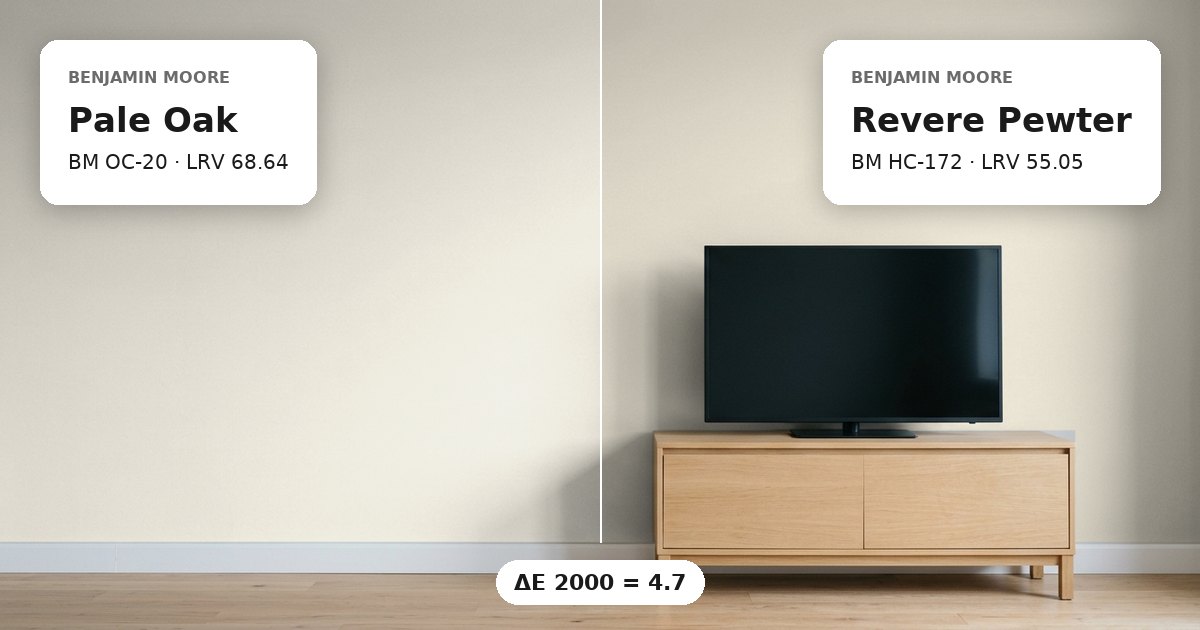
Pale Oak vs Revere Pewter: the measured difference
Pale Oak vs Revere Pewter have a measured color difference of ΔE 4.7, placing them in the category of colors that are only similar rather than nearly interchangeable. Both are greiges with warm yellow undertones, but they differ in lightness and depth. Benjamin Moore Pale Oak (OC-20) has the hex value #DDD9CE, while Benjamin Moore Revere Pewter (HC-172) is #CBC6B8. The lighter numerical appearance of Pale Oak contrasts with the deeper appearance of Revere Pewter. On adjoining walls, this distinction can create a noticeable transition without introducing a completely different color family. Because the two share warm undertones, the change is more about depth and brightness than a switch from warm to cool.
Lightness and depth
Pale Oak has an LRV of 68.64, while Revere Pewter has an LRV of 55.05. Their LRV gap is 13.59 points, so Pale Oak reflects substantially more light under comparable conditions. Pale Oak belongs to the light category, whereas Revere Pewter is classified as a mid-tone. This difference can matter when choosing colors for connected rooms: Pale Oak may help maintain a brighter appearance, while Revere Pewter can give a wall more visual weight. However, LRV is not a guarantee of how bright a color will look in every setting. Window direction, daylight intensity, artificial lighting, and nearby finishes all influence the result. Compare samples in the actual space before using one color in a hallway and the other in an adjoining room.
Undertones and where each works
Both colors have warm yellow undertones, which can help maintain a consistent color direction across connected spaces. North-facing daylight is generally cooler and may make their warmth more apparent. South-facing daylight is typically warmer, so the colors may look different as sunlight changes throughout the day. Pale Oak can work where a light greige is needed, while Revere Pewter offers a deeper option for a neighboring room or feature wall. White trim can create separation around either color, but the trim’s undertone should be considered alongside the warm greige base. For a coordinated transition, place samples near the doorway and view them against the existing flooring. A low-sheen wall finish and a different trim sheen can help distinguish surfaces, although sheen also affects how light reflects from the paint. Check both samples in daylight and under evening lighting before making the final choice.
Before you buy, compare a physical sample with the swatch on Benjamin Moore’s page for Pale Oak and Benjamin Moore’s page for Revere Pewter.
Values from each brand's own color page; ΔE and undertone are our calculations. See methodology. Not affiliated with any paint brand.