 Paint Color Lab
Pale Oak vs Edgecomb Gray
Pale Oak (LRV 68.64) is 5.55 points lighter than Edgecomb Gray (LRV 63.09); ΔE 2.2 means they are very close.
Side by side
| Pale Oak | Edgecomb Gray | |
|---|---|---|
| LRV | 68.64 | 63.09 |
| Undertone | Warm (yellow) | Warm (yellow) |
| Hex | #DDD9CE | #D9D3C4 |
| Depth | Light | Light |
Color difference between them: ΔE 2000 = 2.2 (close, visible side by side).
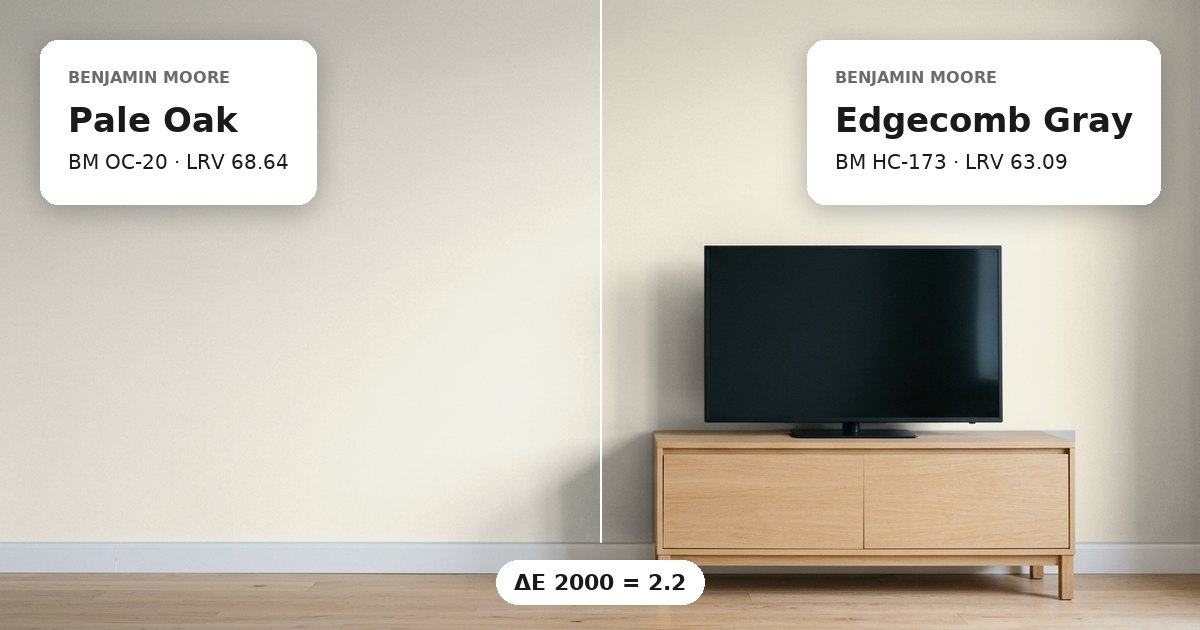
Pale Oak vs Edgecomb Gray: the measured difference
Pale Oak vs Edgecomb Gray have a measured color difference of ΔE 2.2, placing them in the close-but-visible category when viewed side by side. Both are light greiges with warm yellow undertones, so their overall color direction is similar. However, their hex values show subtle differences: Benjamin Moore Pale Oak (OC-20) is #DDD9CE, while Benjamin Moore Edgecomb Gray (HC-173) is #D9D3C4. Edgecomb Gray has a slightly deeper, more beige-leaning numerical appearance, while Pale Oak is lighter. On adjoining walls, this is a relatively restrained distinction rather than a strong change in color family. The difference may become easier to see where the walls meet directly or receive the same light.
Lightness and depth
Pale Oak has an LRV of 68.64, compared with 63.09 for Edgecomb Gray. The difference is 5.55 LRV points, meaning Pale Oak reflects more light and will generally appear brighter under comparable conditions. Both fall within the light category, so neither represents a deep wall color. Pale Oak may help maintain a brighter appearance across a room, while Edgecomb Gray can introduce a little more visual depth without creating a large shift in lightness. Still, actual brightness depends on daylight, artificial lighting, and nearby surfaces. A room with limited window light may make the distinction more noticeable than a bright room does. Test both paints on the same wall or on adjacent sample boards to judge their relative depth accurately.
Undertones and where each works
Both colors have warm yellow undertones, which gives them a shared starting point for coordinating spaces. In north-facing rooms, cooler daylight can make warm undertones stand out more clearly. In south-facing rooms, warmer daylight can reinforce the warmth, although the result depends on the room and surrounding finishes. Pale Oak is a reasonable option where a lighter greige is desired, while Edgecomb Gray can provide a slightly deeper alternative in a connected room. White trim can outline either color, but the trim’s undertone matters: a stark or cool white may create a different contrast from a warmer white. Before painting entire walls, compare samples beside the intended trim and flooring. Check the colors at different times of day, especially where a hallway or doorway connects rooms with different window exposures.
Before you buy, compare a physical sample with the swatch on Benjamin Moore’s page for Pale Oak and Benjamin Moore’s page for Edgecomb Gray.
Values from each brand's own color page; ΔE and undertone are our calculations. See methodology. Not affiliated with any paint brand.