 Paint Color Lab
Balanced Beige SW 7037
Sherwin-Williams Balanced Beige (SW 7037) has an LRV of 46 and a very close match in Valspar Ivory Brown (6006-1C).
- LRV
- 46light reflectance, 0–100
- Undertone
- Warm (yellow)calculated from Lab
- Hex
- #C0B2A2
- RGB
- 192, 178, 162
- CIE Lab
- 73.3 / 2.3 / 10.0D65, from hex
- Depth
- Mid-tone
Closest matches to Balanced Beige in other brands
Ranked by CIEDE2000 colour difference (ΔE). Under 1 is near-identical; under 2 is hard to tell apart on a wall.
| Color | Brand | LRV | ΔE 2000 | How close |
|---|---|---|---|---|
| Ivory Brown Valspar 6006-1C | Valspar | 42.19 | 1.9 | very close |
| Perfect Taupe Behr PPU18-13 | Behr | 42 | 2.7 | close, visible side by side |
| Pashmina BM AF-100 | Benjamin Moore | 44.2 | 2.7 | close, visible side by side |
| Creamy Mushroom Behr PPU5-13 | Behr | 52 | 2.9 | close, visible side by side |
| Thunder BM AF-685 | Benjamin Moore | 47.58 | 4.4 | similar, clearly different |
| Ghost Writer PPG 1007-3 | PPG | 48 | 4.4 | similar, clearly different |
| Smoked Oyster Valspar 6005-1C | Valspar | 36.29 | 5.2 | similar, clearly different |
| Pony Tail PPG 1086-4 | PPG | 50 | 6.5 | similar, clearly different |
Matches come from the 190 colors in our database so far, not from every color each brand makes. Try the color matcher for any hex code.
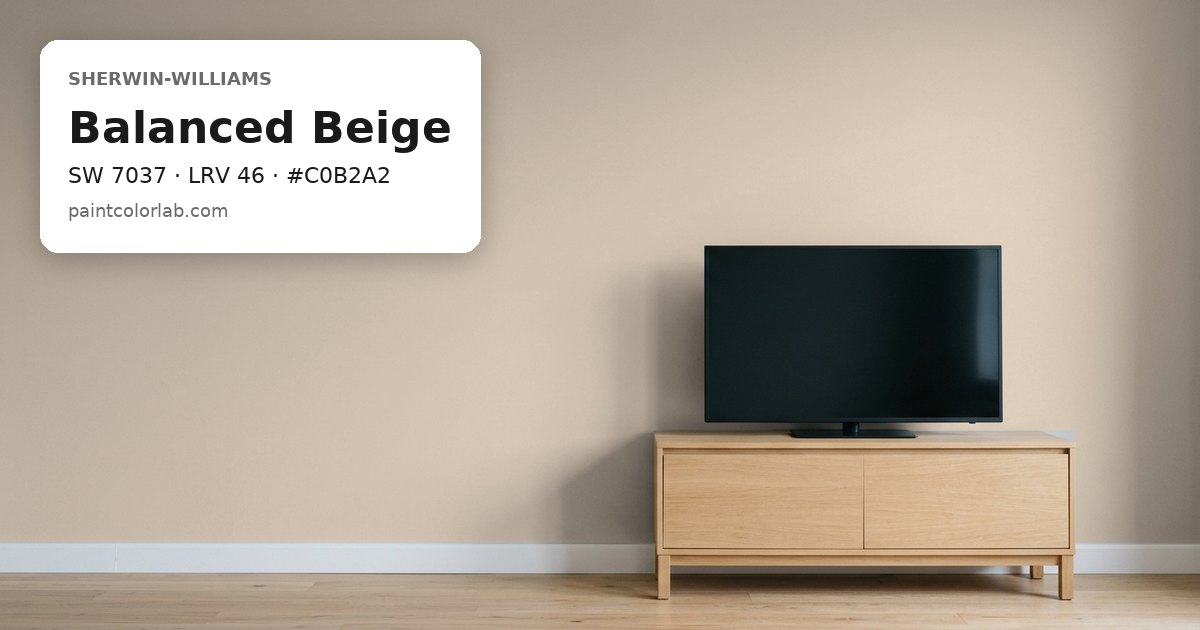
Balanced Beige on a wall
About Balanced Beige
Balanced Beige LRV and undertone
Sherwin-Williams Balanced Beige (SW 7037) has an LRV of 46, placing it in the mid-tone range. Light Reflectance Value measures how much visible light a painted surface reflects. Higher values generally indicate lighter colors, while lower values indicate darker colors. With an LRV of 46, Balanced Beige offers a middle level of reflectance rather than the brightness of a white or the depth of a dark neutral. Its beige color family and calculated warm yellow undertone help explain its appearance. In north-facing rooms, warm undertones can appear more noticeable under cooler daylight. South-facing rooms typically receive warmer light, which can shift the perceived balance. Compare samples on multiple walls before selecting a finish.
Balanced Beige in other brands
Several other brands offer measured color matches, although their LRVs and color differences vary. Valspar Ivory Brown (6006-1C), with an LRV of 42.19 and ΔE 1.9, is a very close match. Behr Perfect Taupe (PPU18-13) and Benjamin Moore Pashmina (AF-100) both have ΔE 2.7, meaning their differences are close but visible side by side. Behr Creamy Mushroom (PPU5-13) has an LRV of 52 and ΔE 2.9, making it another close comparison with greater light reflectance. Benjamin Moore Thunder (AF-685) and PPG Ghost Writer (PPG1007-3) each have ΔE 4.4, so they are only similar rather than close matches. These ΔE 2000 values describe measured color differences, not guaranteed visual results under every lighting condition.
Lighter and darker Sherwin-Williams alternatives
Among the listed Sherwin-Williams alternatives, Amazing Gray (SW 7044) and Anew Gray (SW 7030) each have an LRV of 47 and ΔE 2.5. Their slightly higher LRVs indicate marginally greater light reflectance, making them options to compare when seeking a nearby color with a small brightness difference. Mindful Gray (SW 7016), at LRV 48 and ΔE 4.4, reflects more light and has a more noticeable measured color difference. For a darker alternative, Mega Greige (SW 7031) has an LRV of 37 and ΔE 4.9. Its lower reflectance can give walls greater visual depth. Test each option beside flooring, trim, and furnishings because surrounding colors influence perceived contrast. Use the same sample size and lighting conditions when comparing candidates.
Before you buy, compare a physical sample with the swatch on Sherwin-Williams’s page for Balanced Beige.
Similar Sherwin-Williams colors
Comparisons
More in Beige paint colors.
Hex, RGB and LRV (as published) from Sherwin-Williams's page for this color, checked October 24, 2026. Lab, undertone and ΔE are our calculations. Not affiliated with Sherwin-Williams. See how we measure colors.