 Paint Color Lab
Colonnade Gray SW 7641
Sherwin-Williams Colonnade Gray (SW 7641) has an LRV of 53; Behr Wheat Bread (720C-3) is its closest match at ΔE 2.0.
- LRV
- 53light reflectance, 0–100
- Undertone
- Warm (yellow)calculated from Lab
- Hex
- #C6C0B6
- RGB
- 198, 192, 182
- CIE Lab
- 77.9 / 0.3 / 5.8D65, from hex
- Depth
- Mid-tone
Closest matches to Colonnade Gray in other brands
Ranked by CIEDE2000 colour difference (ΔE). Under 1 is near-identical; under 2 is hard to tell apart on a wall.
| Color | Brand | LRV | ΔE 2000 | How close |
|---|---|---|---|---|
| Wheat Bread Behr 720C-3 | Behr | 56 | 2.0 | very close |
| Thunder BM AF-685 | Benjamin Moore | 47.58 | 2.3 | close, visible side by side |
| Natural Gray Behr PPU18-10 | Behr | 53 | 2.3 | close, visible side by side |
| Revere Pewter BM HC-172 | Benjamin Moore | 55.05 | 2.5 | close, visible side by side |
| Ghost Writer PPG 1007-3 | PPG | 48 | 2.5 | close, visible side by side |
| Heritage Gray Valspar 7007-24 | Valspar | 60 | 2.8 | close, visible side by side |
| Whiskers PPG 1025-3 | PPG | 60 | 3.0 | close, visible side by side |
| Filtered Shade Valspar 4003-1B | Valspar | 58.45 | 3.4 | close, visible side by side |
Matches come from the 190 colors in our database so far, not from every color each brand makes. Try the color matcher for any hex code.
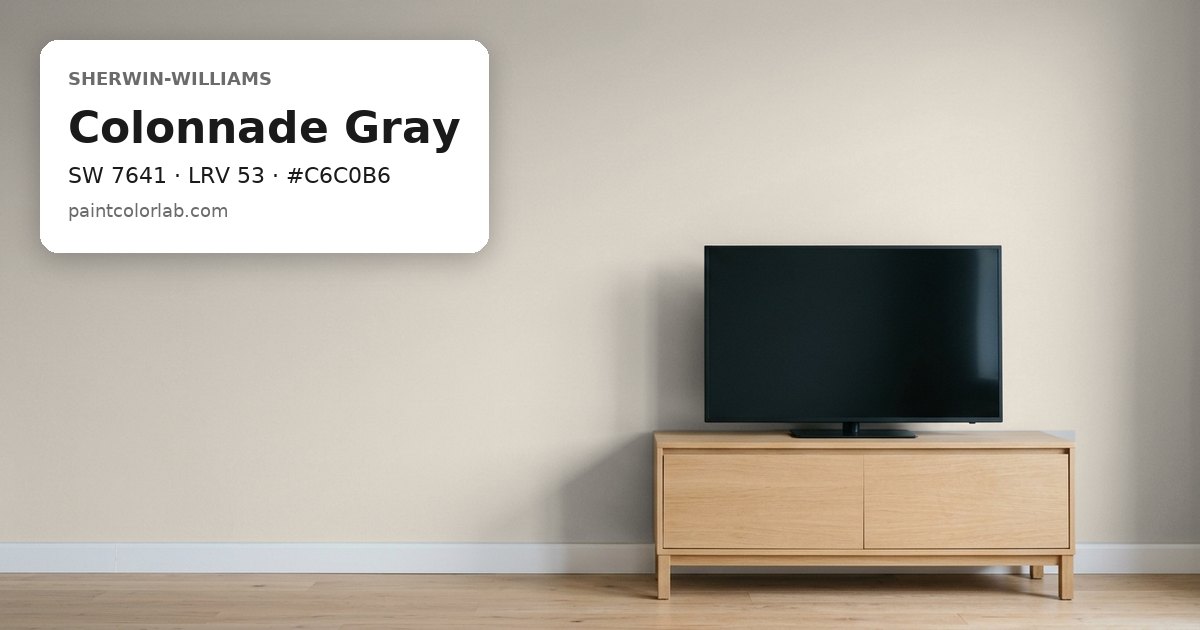
Colonnade Gray on a wall
About Colonnade Gray
Colonnade Gray LRV and undertone
Sherwin-Williams Colonnade Gray (SW 7641) has an LRV of 53, placing it in the mid-tone range. Light Reflectance Value describes how much visible light a painted surface reflects. With an LRV of 53, Colonnade Gray reflects a moderate amount of light, sitting below high-reflectance whites and above darker grays. Its greige color family combines gray and beige characteristics, while its calculated warm yellow undertone can affect how it relates to nearby colors. The same paint may appear different against cool white trim than against warm wood. North-facing light often emphasizes cooler surroundings, while south-facing light tends to reveal more warmth. Before painting an entire room, apply a sample near the floor and trim so you can judge its depth and undertone together.
Colonnade Gray in other brands
Behr Wheat Bread (720C-3) is the nearest listed alternative, with an LRV of 56.0 and a ΔE of 2.0. A ΔE from 2 to 4 indicates a close match, but the difference remains visible when the colors are compared side by side. Benjamin Moore Thunder (AF-685) has an LRV of 47.58 and a ΔE of 2.3, making it darker by reflectance. Behr Natural Gray (PPU18-10) measures 53.0 LRV and has a ΔE of 2.3, giving it the same reflectance value but a visible color difference. Benjamin Moore Revere Pewter (HC-172), at LRV 55.05 and ΔE 2.5, is slightly lighter. These measurements provide a useful starting point for substitutions, not a guarantee of identical results. Compare samples under the room’s actual lighting before selecting a cross-brand match.
Lighter and darker Sherwin-Williams alternatives
Sherwin-Williams Worldly Gray (SW 7043) has an LRV of 57, four points above Colonnade Gray, and a ΔE of 1.9. It is lighter by reflectance and very close in measured color. Sherwin-Williams Mindful Gray (SW 7016), at LRV 48 and ΔE 2.5, is darker and has a close but visible difference. Sherwin-Williams Repose Gray (SW 7015) has an LRV of 58 and a ΔE of 2.6, making it lighter by reflectance. Sherwin-Williams Agreeable Gray (SW 7029), at LRV 60 and ΔE 2.8, also reflects more light. These alternatives allow adjustments in depth without leaving the same brand. Consider a lower-LRV option for a more subdued wall value, or a higher-LRV color when you want the walls to reflect more light. Check the finish and surrounding colors alongside the sample.
Before you buy, compare a physical sample with the swatch on Sherwin-Williams’s page for Colonnade Gray.
Similar Sherwin-Williams colors
More in Greige paint colors.
Hex, RGB and LRV (as published) from Sherwin-Williams's page for this color, checked October 24, 2026. Lab, undertone and ΔE are our calculations. Not affiliated with Sherwin-Williams. See how we measure colors.