 Paint Color Lab
Useful Gray SW 7050
Sherwin-Williams Useful Gray (SW 7050) has an LRV of 59; Behr Toasty Gray (N320-2) is its closest match at ΔE 0.7.
- LRV
- 59light reflectance, 0–100
- Undertone
- Warm (yellow)calculated from Lab
- Hex
- #CFCABD
- RGB
- 207, 202, 189
- CIE Lab
- 81.4 / -0.5 / 7.1D65, from hex
- Depth
- Mid-tone
Closest matches to Useful Gray in other brands
Ranked by CIEDE2000 colour difference (ΔE). Under 1 is near-identical; under 2 is hard to tell apart on a wall.
| Color | Brand | LRV | ΔE 2000 | How close |
|---|---|---|---|---|
| Toasty Gray Behr N320-2 | Behr | 61 | 0.7 | near-identical |
| Tranquil Gray Behr DC-007 | Behr | 60 | 0.9 | near-identical |
| Revere Pewter BM HC-172 | Benjamin Moore | 55.05 | 1.1 | very close |
| Whiskers PPG 1025-3 | PPG | 60 | 1.5 | very close |
| Heritage Gray Valspar 7007-24 | Valspar | 60 | 1.7 | very close |
| Collingwood BM OC-28 | Benjamin Moore | 61.52 | 1.7 | very close |
| Warm Putty Valspar 6006-1A | Valspar | 64.8 | 2.6 | close, visible side by side |
| Toasted Almond PPG 1097-3 | PPG | 61 | 3.8 | close, visible side by side |
Matches come from the 190 colors in our database so far, not from every color each brand makes. Try the color matcher for any hex code.
Useful Gray on a wall
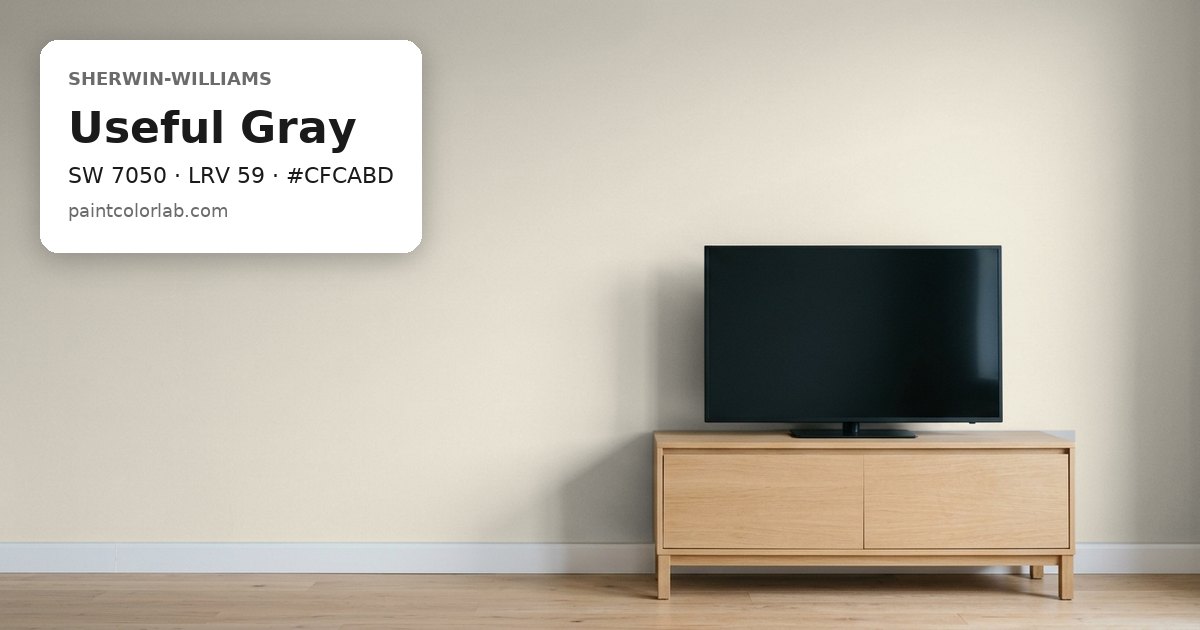
About Useful Gray
Useful Gray LRV and undertone
Sherwin-Williams Useful Gray (SW 7050) has an LRV of 59, placing it in the mid-tone range near the lighter end of that category. Light Reflectance Value indicates how much visible light a color reflects. At 59, Useful Gray reflects more light than dark grays but less than most high-LRV whites. Its greige color family combines characteristics associated with gray and beige, while its calculated warm, yellow undertone identifies the underlying color direction. These properties can influence how the paint reads beside white trim, wood, and other neutral finishes. Lighting also matters: north-facing rooms often make warm colors appear less pronounced, whereas south-facing daylight can emphasize their warmth. Test a sample against existing flooring and trim to see how the undertone interacts with those fixed surfaces.
Useful Gray in other brands
Behr Toasty Gray (N320-2) is the closest listed match, with an LRV of 61.0 and a ΔE of 0.7. A ΔE below 1 indicates a near-identical measured color, although paint finishes and lighting can still affect the comparison. Behr Tranquil Gray (DC-007), at LRV 60.0 and ΔE 0.9, is also near-identical by this measure. Benjamin Moore Revere Pewter (HC-172) has an LRV of 55.05 and a ΔE of 1.1, making it a very close match. PPG Whiskers (PPG1025-3) measures 60.0 LRV with a ΔE of 1.5, also placing it in the very-close range. These figures help narrow the alternatives, but they do not establish identical appearance under every condition. Compare samples side by side before choosing a substitute.
Lighter and darker Sherwin-Williams alternatives
Sherwin-Williams Agreeable Gray (SW 7029) has an LRV of 60, one point higher than Useful Gray, with a ΔE of 1.6. It is slightly lighter by reflectance and remains a very close measured match. Sherwin-Williams Repose Gray (SW 7015), at LRV 58 and ΔE 1.8, is slightly darker. Sherwin-Williams Worldly Gray (SW 7043) has an LRV of 57 and a ΔE of 2.2, giving it a lower reflectance value and a close but visible difference. Sherwin-Williams Accessible Beige (SW 7036), at LRV 58 and ΔE 2.4, is also darker by LRV. Consider the higher-LRV option where you want to preserve more reflected light, or choose a lower-LRV alternative for slightly more depth. Check samples at different times of day before finalizing the color.
Before you buy, compare a physical sample with the swatch on Sherwin-Williams’s page for Useful Gray.
Similar Sherwin-Williams colors
More in Greige paint colors.
Hex, RGB and LRV (as published) from Sherwin-Williams's page for this color, checked October 24, 2026. Lab, undertone and ΔE are our calculations. Not affiliated with Sherwin-Williams. See how we measure colors.