 Paint Color Lab
White Duck SW 7010
Sherwin-Williams White Duck (SW 7010) has an LRV of 74. PPG Hourglass (PPG1022-1) is its nearest match (ΔE 0.9).
- LRV
- 74light reflectance, 0–100
- Undertone
- Warm (yellow)calculated from Lab
- Hex
- #E5DFD2
- RGB
- 229, 223, 210
- CIE Lab
- 89.0 / -0.2 / 7.1D65, from hex
- Depth
- Light
Closest matches to White Duck in other brands
Ranked by CIEDE2000 colour difference (ΔE). Under 1 is near-identical; under 2 is hard to tell apart on a wall.
| Color | Brand | LRV | ΔE 2000 | How close |
|---|---|---|---|---|
| Hourglass PPG 1022-1 | PPG | 75 | 0.9 | near-identical |
| Ballet White BM OC-9 | Benjamin Moore | 71.97 | 1.5 | very close |
| Gilded Linen Valspar 6002-1A | Valspar | 73.84 | 1.7 | very close |
| Antique White PPG 1024-2 | PPG | 72 | 1.7 | very close |
| Campfire Ash Behr N320-1 | Behr | 69 | 1.8 | very close |
| Pale Oak BM OC-20 | Benjamin Moore | 68.64 | 1.8 | very close |
| Cozy White Valspar 3008-10C | Valspar | 79.76 | 1.8 | very close |
| Silver Drop Behr 790C-2 | Behr | 70 | 1.9 | very close |
Matches come from the 190 colors in our database so far, not from every color each brand makes. Try the color matcher for any hex code.
White Duck on a wall
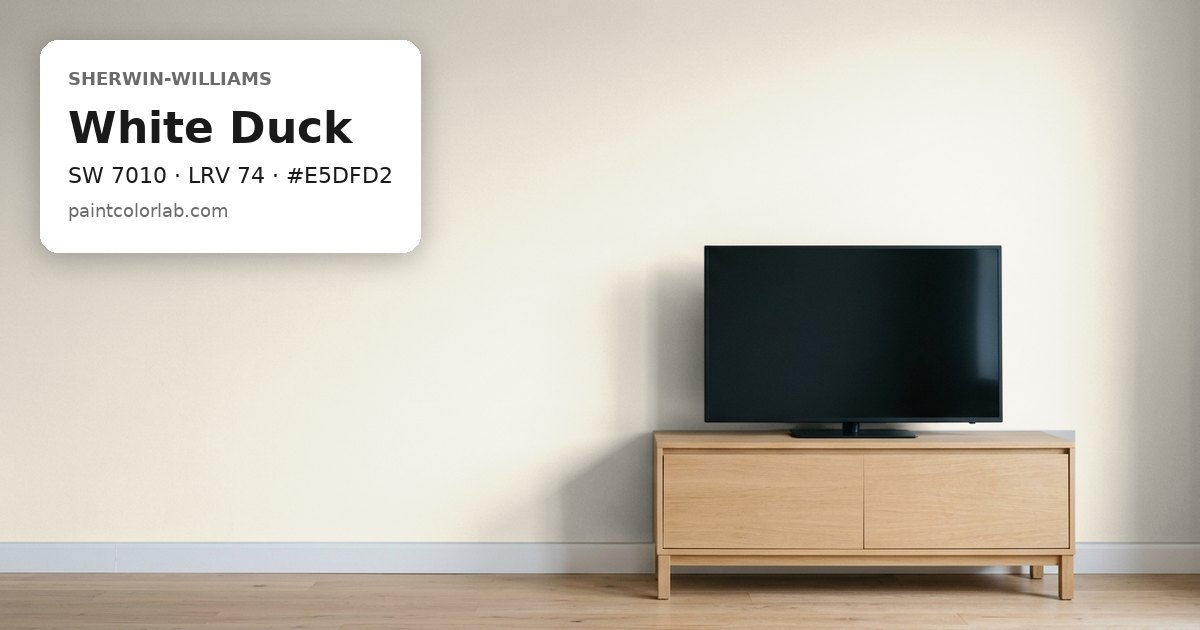
About White Duck
White Duck LRV and undertone
Sherwin-Williams White Duck (SW 7010) has an LRV of 74, placing it in the light range. Light Reflectance Value measures how much visible light a color reflects, from 0 to 100. At 74, White Duck reflects a substantial amount of light without reaching the highest reflectance levels associated with brighter whites. Its color family is White, and its calculated undertone is warm yellow. That warmth can become more apparent beside cooler whites or under different lighting conditions. Therefore, compare it with nearby finishes rather than judging the paint in isolation.
Natural light changes throughout the day. North-facing rooms typically receive cooler daylight, while south-facing rooms generally receive warmer, more direct light. These shifts can influence how a warm white appears on a large wall. Test a sample beside flooring, counters, and trim. A brighter white trim may create a noticeable boundary, whereas a closely matched white can reduce the apparent contrast. Sheen also affects reflected light, so compare samples using the finish you plan to apply.
White Duck in other brands
PPG Hourglass (PPG1022-1) has an LRV of 75 and a ΔE of 0.9 relative to White Duck. A difference under 1 means the colors are near-identical in the supplied comparison. Benjamin Moore Ballet White (OC-9), with an LRV of 71.97, has a ΔE of 1.5, making it a very close match. Valspar Gilded Linen (6002-1A), at LRV 73.84, has a ΔE of 1.7. PPG Antique White (PPG1024-2), at LRV 72, also has a ΔE of 1.7. These are very close color comparisons, although actual results can vary with lighting and finish.
Lighter and darker Sherwin-Williams alternatives
Sherwin-Williams Oyster White (SW 7637), at LRV 72, is slightly darker than White Duck, with a ΔE of 0.7. Sherwin-Williams Shoji White (SW 7042) shares an LRV of 74 and has a ΔE of 0.8, making it near-identical in the supplied comparison but not lighter or darker by LRV. Sherwin-Williams Pearly White (SW 7009), at LRV 77, is lighter and reflects more light. Sherwin-Williams Creamy (SW 7012), at LRV 81, is lighter still. Consider Pearly White or Creamy when you want greater reflectance; Oyster White suits a slightly deeper result. Sample each beside the room’s fixed finishes before choosing.
Before you buy, compare a physical sample with the swatch on Sherwin-Williams’s page for White Duck.
Similar Sherwin-Williams colors
More in White paint colors.
Hex, RGB and LRV (as published) from Sherwin-Williams's page for this color, checked October 24, 2026. Lab, undertone and ΔE are our calculations. Not affiliated with Sherwin-Williams. See how we measure colors.