 Paint Color Lab
Cameo White Behr MQ3-32
Behr Cameo White (MQ3-32) has an LRV of 81 and is nearly identical to Valspar Summer Gray (7006-17), with ΔE 0.2.
- LRV
- 81light reflectance, 0–100
- Undertone
- Subtle warm (yellow)calculated from Lab
- Hex
- #EBE8E2
- RGB
- 235, 232, 226
- CIE Lab
- 92.1 / -0.0 / 3.3D65, from hex
- Depth
- Light
Closest matches to Cameo White in other brands
Ranked by CIEDE2000 colour difference (ΔE). Under 1 is near-identical; under 2 is hard to tell apart on a wall.
| Color | Brand | LRV | ΔE 2000 | How close |
|---|---|---|---|---|
| Summer Gray Valspar 7006-17 | Valspar | 80.27 | 0.2 | near-identical |
| Snowbound SW 7004 | Sherwin-Williams | 83 | 0.7 | near-identical |
| Pure White SW 7005 | Sherwin-Williams | 84 | 1.3 | very close |
| Commercial White PPG 1025-1 | PPG | 83 | 1.3 | very close |
| Du Jour Valspar 7002-6 | Valspar | 86.04 | 1.5 | very close |
| Silver Satin BM OC-26 | Benjamin Moore | 74.9 | 2.1 | close, visible side by side |
| White Dove BM OC-17 | Benjamin Moore | 83.16 | 2.3 | close, visible side by side |
| Aria PPG 1001-2 | PPG | 77 | 2.6 | close, visible side by side |
Matches come from the 190 colors in our database so far, not from every color each brand makes. Try the color matcher for any hex code.
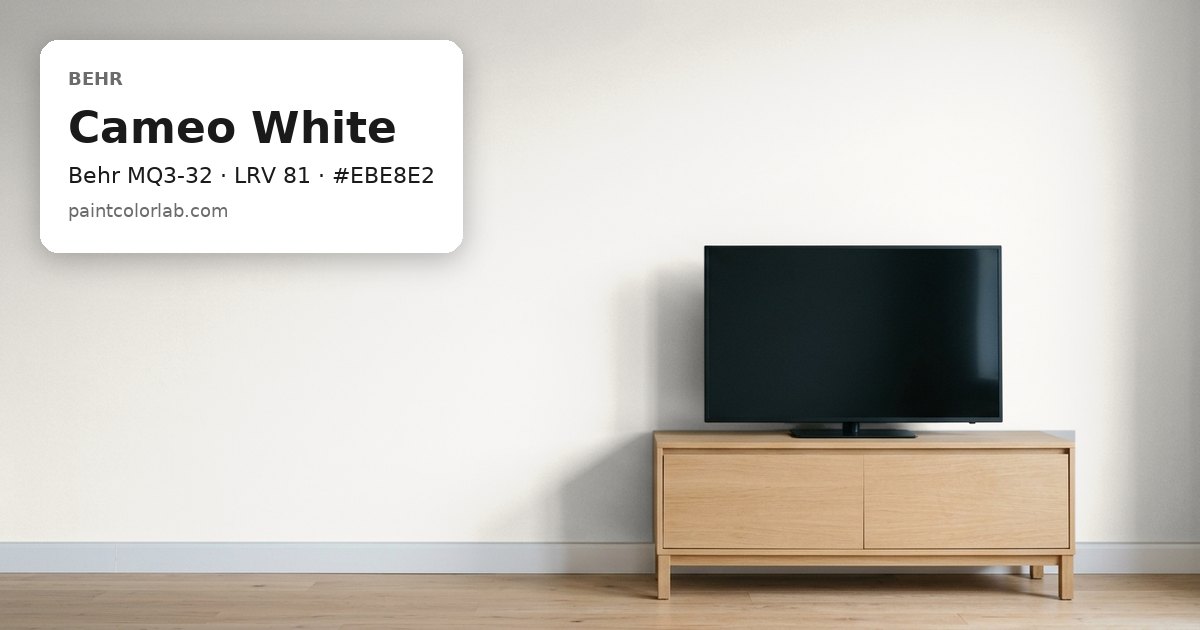
Cameo White on a wall
About Cameo White
Behr Cameo White (MQ3-32) LRV and undertone
Behr Cameo White (MQ3-32) has an LRV of 81, placing it in the light range with a white color family classification. Its hexadecimal value is #EBE8E2, and its calculated undertone is subtly warm with yellow influence. Light reflectance value (LRV) measures how much visible light a color reflects, on a scale from 0 for black to 100 for pure white. At 81, Cameo White reflects substantial light, which can help a room feel brighter without requiring a stark white finish. Its yellow undertone may become more noticeable in warm artificial lighting or alongside cooler whites. North-facing rooms often receive cooler daylight, while south-facing rooms generally receive warmer, stronger light. Therefore, evaluate the color under the lighting conditions of the intended space.
Behr Cameo White in other brands
Several cross-brand colors have low measured color differences from Cameo White. Valspar Summer Gray (7006-17), with an LRV of 80.27 and ΔE 0.2, is a near-identical match by the supplied color comparison. Sherwin-Williams Snowbound (SW 7004), at LRV 83 and ΔE 0.7, is also near-identical. Sherwin-Williams Pure White (SW 7005) and PPG Commercial White (PPG1025-1) each have ΔE 1.3, making them very close matches. Valspar Du Jour (7002-6), at ΔE 1.5, is another very close option. In this comparison, ΔE below 1 means near-identical, 1 to 2 means very close, 2 to 4 means close but visibly different side by side, and above 4 means only similar. Benjamin Moore Silver Satin (OC-26), at ΔE 2.1, is close but visibly different beside the original.
Lighter and darker Behr alternatives
For a lighter alternative, Behr Whipped Cream (DC-001) has an LRV of 91, while Behr Polar Bear (75) has an LRV of 90. Both reflect more light than Cameo White, making them options when greater brightness is the priority. Behr Ultra Pure White (UPW), with an LRV of 94, offers an even higher-reflectance choice. Behr Swiss Coffee (12), at LRV 84, is also lighter, although its LRV difference is smaller. All four alternatives have supplied ΔE values between 2.8 and 3.9, indicating visible differences beside the original. For a coordinated white palette, compare samples on the same wall and observe them throughout the day. The apparent contrast can change with natural light, nearby finishes, and paint sheen. Use sample boards before choosing the final color, particularly where walls meet trim.
Before you buy, compare a physical sample with the swatch on Behr’s page for Cameo White.
Similar Behr colors
More in White paint colors.
Hex, RGB and LRV (as published) from Behr's page for this color, checked October 24, 2026. Lab, undertone and ΔE are our calculations. Not affiliated with Behr. See how we measure colors.