 Paint Color Lab
Gray Heron PPG 1033-5
PPG Gray Heron (PPG1033-5) has an LRV of 28 and is closest to Sherwin-Williams Acacia Haze (SW 9132), with ΔE 3.8.
- LRV
- 28light reflectance, 0–100
- Undertone
- Greencalculated from Lab
- Hex
- #89928A
- RGB
- 137, 146, 138
- CIE Lab
- 59.6 / -4.8 / 3.1D65, from hex
- Depth
- Dark
Closest matches to Gray Heron in other brands
Ranked by CIEDE2000 colour difference (ΔE). Under 1 is near-identical; under 2 is hard to tell apart on a wall.
| Color | Brand | LRV | ΔE 2000 | How close |
|---|---|---|---|---|
| Acacia Haze SW 9132 | Sherwin-Williams | 32 | 3.8 | close, visible side by side |
| Café Blue Valspar 5001-4A | Valspar | 29.07 | 4.2 | similar, clearly different |
| Evergreen Fog SW 9130 | Sherwin-Williams | 30 | 4.2 | similar, clearly different |
| Muted Sage Behr N350-5 | Behr | 28 | 6.6 | similar, clearly different |
| Chelsea Gray BM HC-168 | Benjamin Moore | 23.33 | 6.8 | similar, clearly different |
| Warm Eucalyptus Valspar 8004-28F | Valspar | 21 | 7.7 | same family only |
| Jungle Camouflage Behr N350-4 | Behr | 38 | 9.8 | same family only |
| Boothbay Gray BM HC-165 | Benjamin Moore | 43.26 | 10.5 | same family only |
Matches come from the 190 colors in our database so far, not from every color each brand makes. Try the color matcher for any hex code.
Gray Heron on a wall
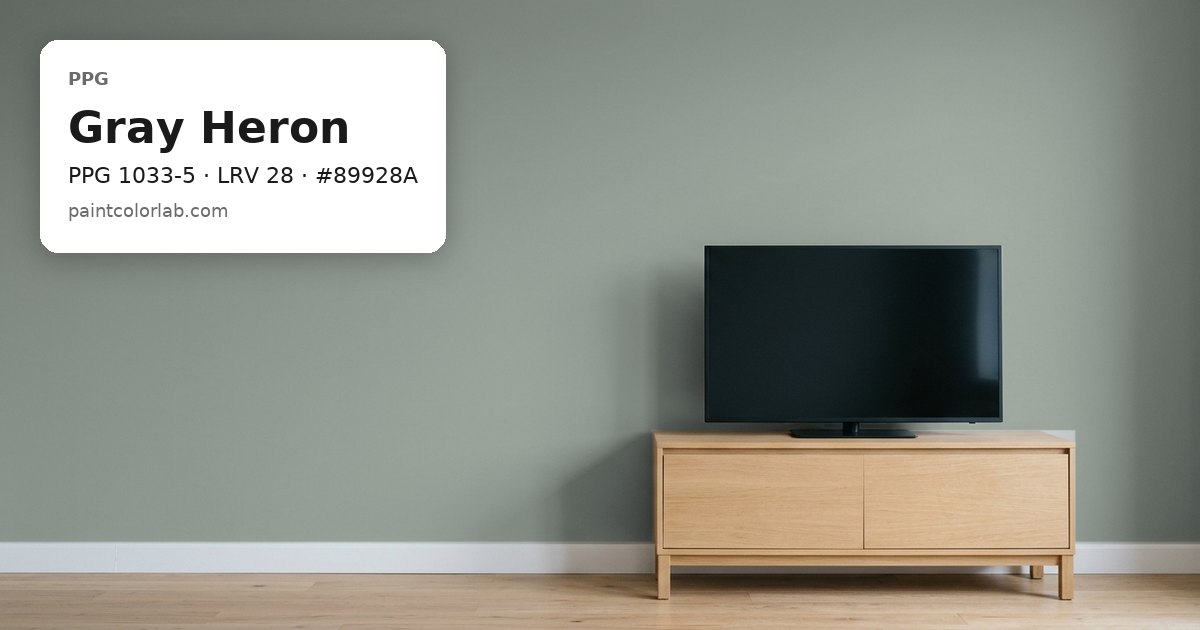
About Gray Heron
Gray Heron LRV and undertone
PPG Gray Heron (PPG1033-5) has an LRV of 28, placing it in the dark range. Light reflectance value measures how much visible light a paint color reflects. With an LRV of 28, Gray Heron reflects less light than mid-tone paints, which can make it appear deeper in a room with limited daylight. Its color family is green, and its calculated undertone is green. The hex value is #89928A. These facts describe its measured characteristics, but lighting, sheen, and adjacent colors can affect the finished appearance.
In north-facing rooms, cooler daylight may make green undertones look cooler, while stronger southern exposure can increase apparent brightness. Consider the room’s natural light and the contrast with existing trim. White trim can separate the wall color clearly, while similar mid-tone finishes may create a subtler transition. Test a sample near windows and in darker corners before deciding.
Gray Heron in other brands
Sherwin-Williams Acacia Haze (SW 9132) is the nearest listed alternative, with an LRV of 32 and ΔE 3.8. This is a close match, although the difference remains visible when both colors sit side by side. Valspar Café Blue (5001-4A), at LRV 29.07 and ΔE 4.2, is only similar. Sherwin-Williams Evergreen Fog (SW 9130), with an LRV of 30 and ΔE 4.2, also falls into the similar category. Behr Muted Sage (N350-5), at LRV 28 and ΔE 6.6, has the same LRV but differs more in measured color.
ΔE 2000 describes the measured difference between two colors. Under 1 means near-identical; 1 to 2 means very close; and 2 to 4 means close but visibly different side by side. Values over 4 mean only similar. Acacia Haze is therefore the strongest listed cross-brand match, while the other comparisons require more visual compromise.
Lighter and darker PPG alternatives
PPG Farm Fresh (PPG1129-5) has an LRV of 31, three points higher than Gray Heron, making it lighter by reflectance. PPG After the Storm (PPG1036-4), at LRV 34, is six points higher and belongs to the mid-tone range. PPG Stonehenge Greige (PPG1024-5), also at LRV 34, provides another higher-reflectance option. These colors may suit rooms where a lighter wall is needed, but their ΔE values show that none is a near-identical replacement.
The supplied same-brand options do not include a color with an LRV below 28, so no darker alternative can be identified from this list. When comparing these options, use sample boards under the room’s actual lighting and check their relationship to flooring and trim.
Before you buy, compare a physical sample with the swatch on PPG’s page for Gray Heron.
Similar PPG colors
More in Green paint colors.
Hex, RGB and LRV (as published) from PPG's page for this color, checked October 24, 2026. Lab, undertone and ΔE are our calculations. Not affiliated with PPG. See how we measure colors.