 Paint Color Lab
Knight’s Armor PPG 1001-6
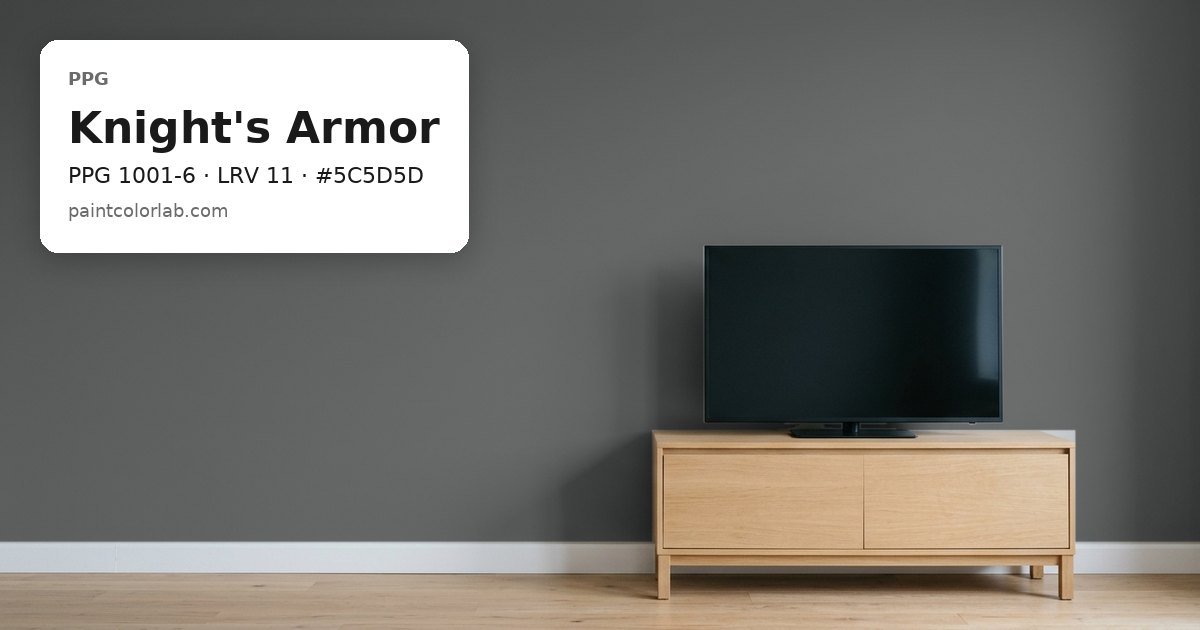
PPG Knight's Armor (PPG1001-6) has an LRV of 11 and a neutral gray undertone, closest to Sherwin-Williams Peppercorn (SW 7674).
- LRV
- 11light reflectance, 0–100
- Undertone
- Neutralcalculated from Lab
- Hex
- #5C5D5D
- RGB
- 92, 93, 93
- CIE Lab
- 39.4 / -0.4 / -0.1D65, from hex
- Depth
- Dark
Closest matches to Knight’s Armor in other brands
Ranked by CIEDE2000 colour difference (ΔE). Under 1 is near-identical; under 2 is hard to tell apart on a wall.
| Color | Brand | LRV | ΔE 2000 | How close |
|---|---|---|---|---|
| Peppercorn SW 7674 | Sherwin-Williams | 10 | 1.8 | very close |
| Iron Mountain BM 2134-30 | Benjamin Moore | 10.96 | 3.3 | close, visible side by side |
| Grizzle Gray SW 7068 | Sherwin-Williams | 13 | 3.5 | close, visible side by side |
| Kendall Charcoal BM HC-166 | Benjamin Moore | 14.61 | 4.1 | similar, clearly different |
| Midnight Blue Behr N480-7 | Behr | 9 | 6.2 | similar, clearly different |
| Almost Charcoal Valspar 4008-2B | Valspar | 15.93 | 7.2 | same family only |
| Flora Valspar 5004-2C | Valspar | 9.3 | 8.3 | same family only |
| Adirondack Blue Behr N480-5 | Behr | 23 | 16.5 | same family only |
Matches come from the 190 colors in our database so far, not from every color each brand makes. Try the color matcher for any hex code.
Knight’s Armor on a wall
About Knight’s Armor
PPG Knight’s Armor (PPG1001-6) LRV and undertone
PPG Knight’s Armor (PPG1001-6) has an LRV of 11, placing it firmly in the dark range. LRV measures the percentage of visible light a surface reflects, so a low value generally means a painted wall reflects less light. Its color family is gray, and its calculated undertone is neutral. This combination makes Knight’s Armor a dark gray without a calculated warm or cool undertone. In a room, the limited light reflection can make wall surfaces appear deeper than lighter gray alternatives.
Room size, window placement, and artificial lighting affect how a dark gray reads. Before painting an entire room, check a large sample during both daytime and evening conditions. A lighter ceiling or trim can establish a clearer boundary against the walls, while a coordinated dark finish can reduce the apparent contrast. Sheen also affects reflected light, so evaluate the intended paint finish rather than relying on a small color chip alone.
PPG Knight’s Armor in other brands
Sherwin-Williams Peppercorn (SW 7674) is the nearest listed match, with an LRV of 10 and a ΔE of 1.8. A ΔE between 1 and 2 indicates a very close match, although the colors are not necessarily identical. Benjamin Moore Iron Mountain (2134-30) has an LRV of 10.96 and a ΔE of 3.3. That places it in the close-but-visible range when the two colors appear side by side.
Sherwin-Williams Grizzle Gray (SW 7068) has an LRV of 13 and a ΔE of 3.5, making it another close but visibly different option. Benjamin Moore Kendall Charcoal (HC-166), with an LRV of 14.61 and a ΔE of 4.1, is only similar by the stated threshold. These values describe measured color difference, not guaranteed appearance under every light source.
Lighter and darker PPG alternatives
PPG Black Magic (PPG1001-7) has an LRV of 4, making it substantially darker than Knight’s Armor. It can suit an application where very low light reflection is desired. PPG Sarsaparilla (PPG1018-7), at an LRV of 8, is also darker, although its calculated undertone is warm red and its color family is brown. PPG Cavalry (PPG1041-7) has an LRV of 7, providing another darker alternative.
PPG Night Watch (PPG1145-7) has an LRV of 6 and is darker by light reflectance as well. Because the listed alternatives have different color characteristics, compare undertones alongside LRV. Test samples near flooring and trim to judge both brightness and contrast before committing to a full wall.
Before you buy, compare a physical sample with the swatch on PPG’s page for Knight’s Armor.
Similar PPG colors
More in Gray paint colors.
Hex, RGB and LRV (as published) from PPG's page for this color, checked October 24, 2026. Lab, undertone and ΔE are our calculations. Not affiliated with PPG. See how we measure colors.