 Paint Color Lab
Worldly Gray vs Agreeable Gray
Worldly Gray has an LRV of 57 versus 60 for Agreeable Gray, a 3-point difference; ΔE is 1.5.
Side by side
| Worldly Gray | Agreeable Gray | |
|---|---|---|
| LRV | 57 | 60 |
| Undertone | Warm (yellow) | Warm (yellow) |
| Hex | #CEC6BB | #D1CBC1 |
| Depth | Mid-tone | Light |
Color difference between them: ΔE 2000 = 1.5 (very close).
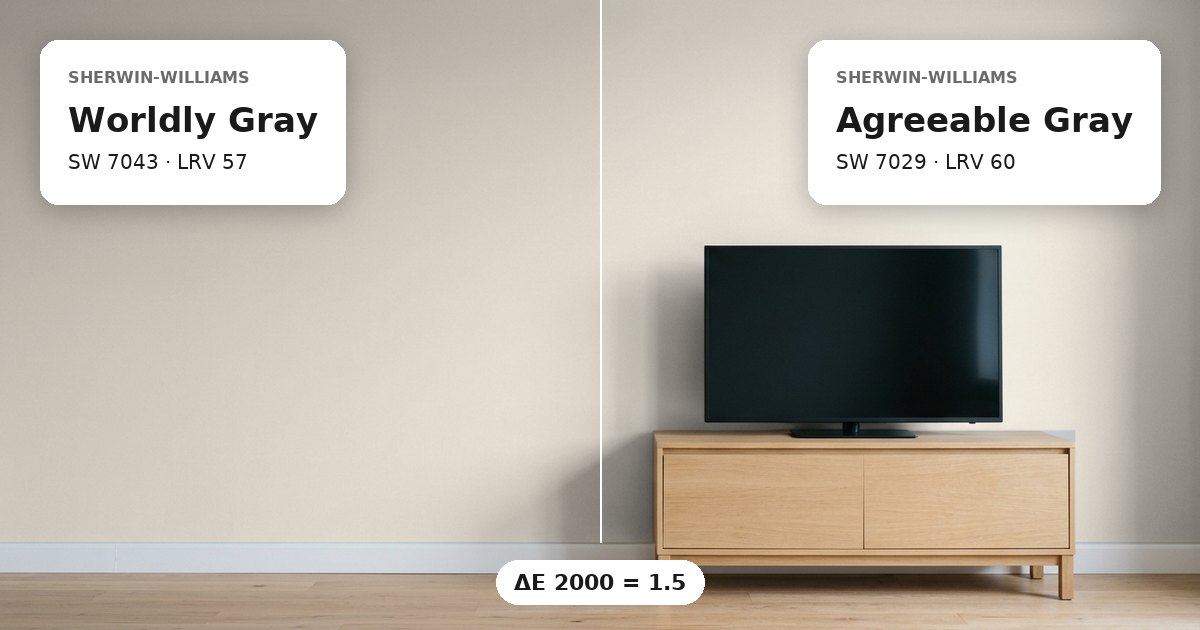
Worldly Gray vs Agreeable Gray: the measured difference
Worldly Gray vs Agreeable Gray have a ΔE 2000 of 1.5, meaning they are very close in measured color difference. Both are greiges with warm yellow undertones, so they share a similar underlying color direction. However, a small ΔE does not mean the colors will look identical in every room. Their difference can still appear along adjoining walls, especially where lighting or surrounding finishes emphasize subtle variations. Sherwin-Williams Worldly Gray has the lower LRV, giving it a slightly deeper profile than Agreeable Gray. Their close relationship may support a restrained transition between connected spaces, while the small change in reflectance provides some separation. Sample both in the intended setting to determine how clearly the difference appears.
Lightness and depth
Sherwin-Williams Worldly Gray (SW 7043) has an LRV of 57, while Sherwin-Williams Agreeable Gray (SW 7029) has an LRV of 60. The gap is 3 LRV points. LRV measures the amount of visible light reflected by a painted surface, so Agreeable Gray generally reflects slightly more light than Worldly Gray. Under comparable conditions, Agreeable Gray may therefore appear a little brighter, while Worldly Gray may show more depth. The numerical difference is modest, so the brightness contrast may remain subtle on finished walls. Room orientation, window size, and artificial lighting can influence the perceived result. Use the LRV figures as a guide to relative reflectance rather than a precise forecast of the colors’ appearance.
Undertones and where each works
Both colors have warm yellow undertones, making them related options for a greige palette. In north-facing rooms, cooler daylight can change the way warm undertones register, while south-facing light often adds a warmer cast. The final appearance also depends on flooring, furnishings, and nearby paint colors. Worldly Gray may be considered where slightly more depth is wanted; Agreeable Gray offers a modestly higher reflectance value for a somewhat lighter wall treatment. These are general comparisons based on their supplied measurements, not guarantees about every room.
White trim can define the edges of either greige, but the amount of contrast depends on the trim white’s own brightness and undertones. For adjoining rooms, use the lower-LRV Worldly Gray where you want a slightly deeper transition and Agreeable Gray where more reflectance is useful. Test the colors beside each other and next to the actual trim. Observe them at different times of day, including under artificial light. Consistent sheen can help maintain a similar surface appearance, while different sheens may affect reflected light and make the transition more noticeable.
Before you buy, compare a physical sample with the swatch on Sherwin-Williams’s page for Worldly Gray and Sherwin-Williams’s page for Agreeable Gray.
Values from each brand's own color page; ΔE and undertone are our calculations. See methodology. Not affiliated with any paint brand.