 Paint Color Lab
White Dove vs Pure White
White Dove has an LRV of 83.16 versus 84 for Pure White, a 0.84-point difference; ΔE is 1.4.
Side by side
| White Dove | Pure White | |
|---|---|---|
| LRV | 83.16 | 84 |
| Undertone | Warm (yellow) | Subtle warm (yellow) |
| Hex | #EFEEE5 | #EDECE6 |
| Depth | Light | Light |
Color difference between them: ΔE 2000 = 1.4 (very close).
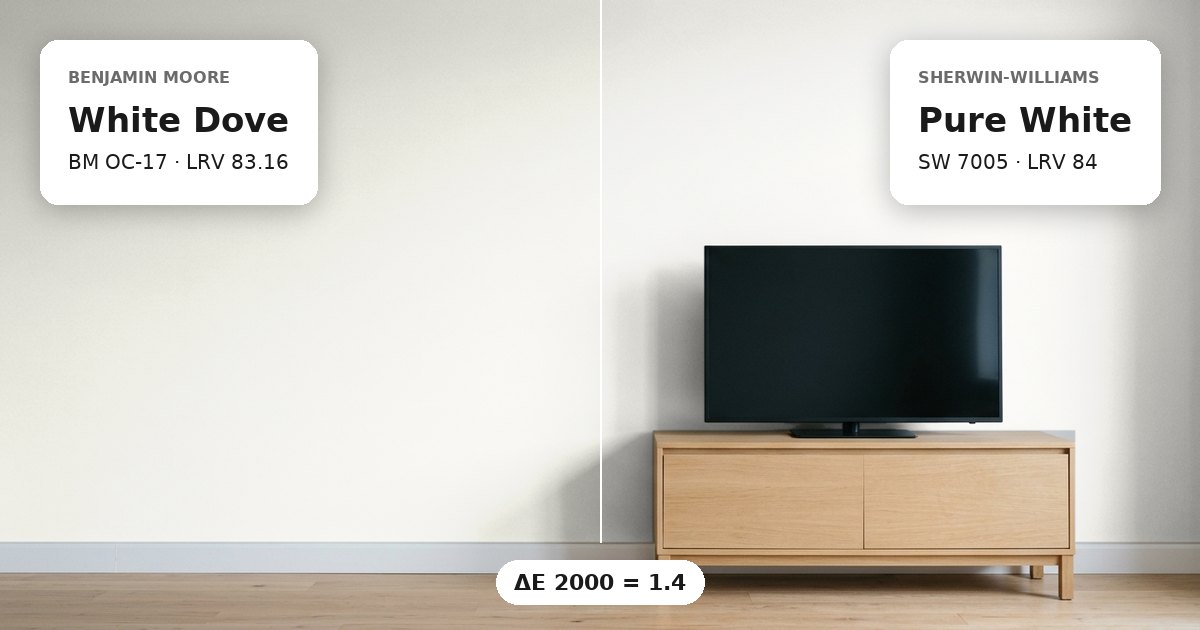
White Dove vs Pure White: the measured difference
White Dove vs Pure White have a ΔE 2000 of 1.4, placing them in the very close range. Their measured difference is small, but it can still be visible when the colors sit beside each other on walls or trim. Benjamin Moore White Dove has a warm yellow undertone, while Sherwin-Williams Pure White has a subtle warm yellow undertone. These descriptions indicate a shared warm direction, although the strength of that warmth differs. The colors therefore offer a related appearance without guaranteeing an exact match. In connected rooms, any distinction may be subtle under consistent lighting, yet surrounding finishes and daylight can make it easier to notice. Their individual LRVs provide another useful point of comparison.
Lightness and depth
Benjamin Moore White Dove (OC-17) has an LRV of 83.16, compared with an LRV of 84 for Sherwin-Williams Pure White (SW 7005). The difference is 0.84 LRV points. Both values indicate high light reflectance, so both colors generally appear bright in suitable lighting. Pure White has the slightly higher LRV, but this small gap may not produce an obvious brightness difference on a finished wall. The warmer undertone of White Dove can influence its appearance independently of its lightness measurement. As a result, the two whites may look different even when their reflectance levels seem nearly identical. Evaluate both the undertone and LRV when deciding how they should work together.
Undertones and where each works
White Dove’s warm yellow undertone is more explicitly described as warm, while Pure White’s is characterized as subtly warm yellow. North-facing rooms usually receive cooler daylight, which may make warm whites appear less yellow or create a different contrast with nearby colors. South-facing rooms receive warmer, more direct light that can emphasize yellow undertones. These are general tendencies, and actual results depend on the room, light bulbs, and adjacent surfaces.
Either color can be evaluated for walls or trim, depending on whether you want a subtle variation or a consistent white across surfaces. When pairing them, apply samples directly beside each other so you can assess their undertones and brightness together. White trim against a warmer wall can produce a visible boundary, but the effect depends on both colors and their finishes. In adjoining rooms, consider how the transition looks from the doorway as well as from within each space. Check samples in morning daylight, afternoon light, and after dark before making a final choice.
Before you buy, compare a physical sample with the swatch on Benjamin Moore’s page for White Dove and Sherwin-Williams’s page for Pure White.
Values from each brand's own color page; ΔE and undertone are our calculations. See methodology. Not affiliated with any paint brand.