 Paint Color Lab
Snowbound vs Pure White
Snowbound has an LRV of 83 versus 84 for Pure White, a 1-point difference; ΔE is 1.3.
Side by side
| Snowbound | Pure White | |
|---|---|---|
| LRV | 83 | 84 |
| Undertone | Subtle warm (yellow) | Subtle warm (yellow) |
| Hex | #EDEAE5 | #EDECE6 |
| Depth | Light | Light |
Color difference between them: ΔE 2000 = 1.3 (very close).
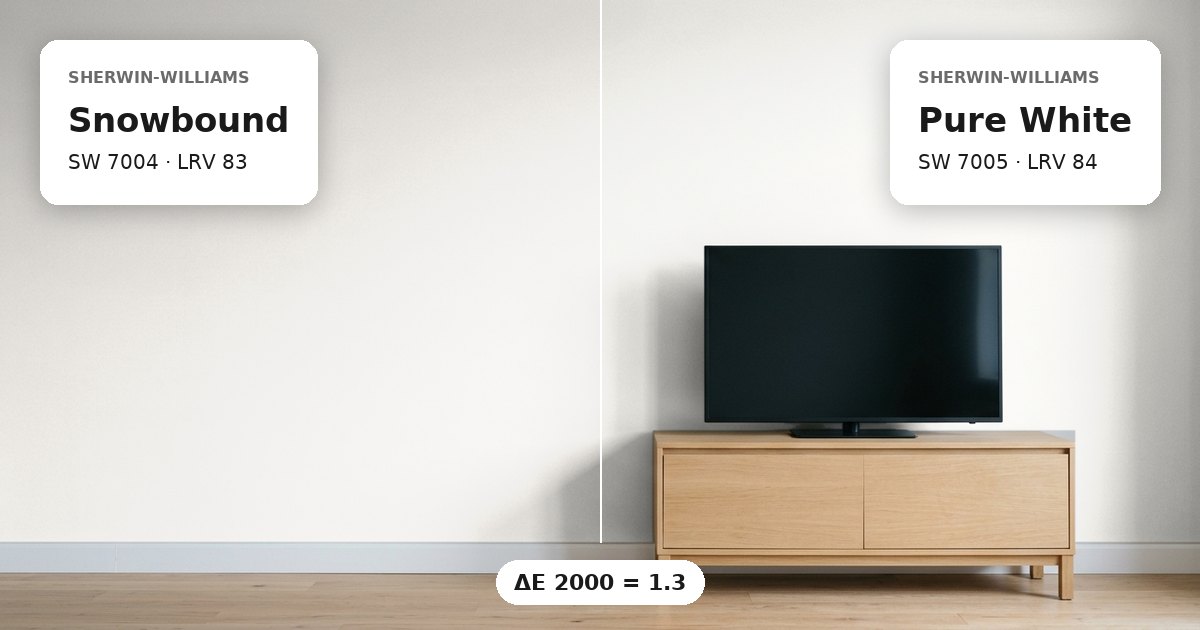
Snowbound vs Pure White: the measured difference
Snowbound vs Pure White have a ΔE 2000 of 1.3, so they are very close in measured color difference. Their visual distinction is relatively subtle, although it may become noticeable when the paints meet along a wall, doorway, or trim edge. Both colors are whites with subtle warm yellow undertones. This shared characteristic helps keep them within a similar color family, but it does not make them identical. Sherwin-Williams Pure White has a slightly higher LRV than Snowbound, while the measured ΔE indicates that their overall color difference remains small. In adjoining rooms, the transition is likely to look restrained under comparable lighting, with the undertones and reflectance contributing to any visible variation.
Lightness and depth
Sherwin-Williams Snowbound (SW 7004) has an LRV of 83, and Sherwin-Williams Pure White (SW 7005) has an LRV of 84. Their difference is 1 LRV point. Light reflectance value measures how much visible light a surface reflects. Because both values are high, both colors generally fall into the light, bright-white range. Pure White has the marginally higher reflectance value and may appear slightly brighter under comparable conditions. However, a one-point gap does not necessarily create a clear brightness contrast once the paint is on the wall. Daylight, artificial lighting, surface area, and neighboring finishes can influence the result. Their measured lightness is therefore a useful starting point, not a guarantee of how the finished colors will compare.
Undertones and where each works
Both whites have subtle warm yellow undertones, so either may show some warmth depending on the light. North-facing rooms tend to receive cooler daylight, while south-facing rooms usually receive warmer, more direct light. Those conditions can alter how warm undertones are perceived. The effect also depends on the room’s furnishings, flooring, and light bulbs. Test both colors in the intended location before deciding which one better fits the surrounding materials.
Snowbound and Pure White can be compared for walls, trim, or adjoining spaces when a small difference in white is acceptable. If you use one on the walls and the other on trim, inspect the edge carefully; subtle differences can become easier to spot where surfaces meet. A compatible sheen can help maintain a consistent finish, while different sheens may change the way light reflects across the surfaces. Apply samples on large boards and move them between rooms if necessary. Review them in daylight and after dark to determine whether their slight difference remains appropriate throughout the day.
Before you buy, compare a physical sample with the swatch on Sherwin-Williams’s page for Snowbound and Sherwin-Williams’s page for Pure White.
Values from each brand's own color page; ΔE and undertone are our calculations. See methodology. Not affiliated with any paint brand.