 Paint Color Lab
Shoji White vs Alabaster
Shoji White has an LRV of 74 and Alabaster 82, an 8-point difference; ΔE 3.0 means they are close but visibly different.
Side by side
| Shoji White | Alabaster | |
|---|---|---|
| LRV | 74 | 82 |
| Undertone | Warm (yellow) | Warm (yellow) |
| Hex | #E6DFD3 | #EDEAE0 |
| Depth | Light | Light |
Color difference between them: ΔE 2000 = 3.0 (close, visible side by side).
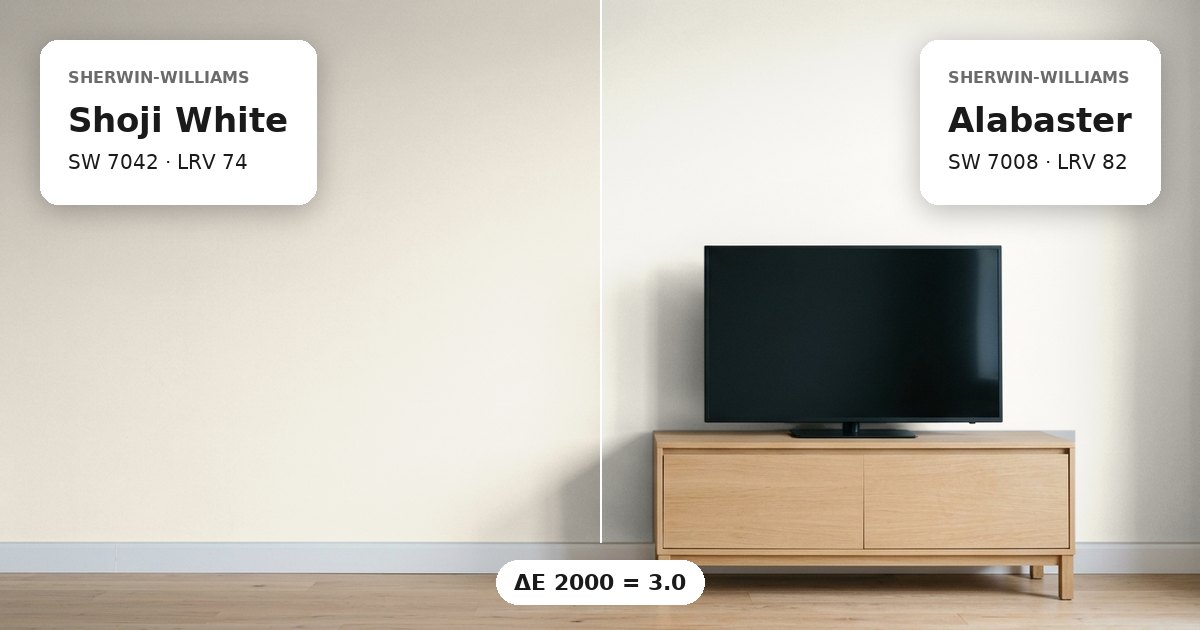
Shoji White vs Alabaster: the measured difference
Shoji White vs Alabaster have a ΔE 2000 of 3.0, meaning they are close but visibly different when placed side by side. Both are light colors classified as white, and both have warm yellow undertones. However, their hex values show a measurable distinction: Shoji White is #E6DFD3, while Alabaster is #EDEAE0. On adjoining walls, Alabaster should generally look lighter, while Shoji White should appear more muted and deeper. Their shared warmth does not eliminate the difference in brightness and color.
When planning connected rooms, consider whether you want a subtle transition or a more noticeable change between wall surfaces. The ΔE value indicates a difference that can be visible when the paints meet directly. Lighting and surrounding finishes may increase or reduce the apparent contrast. Test both colors together near the doorway or corner where the transition will occur, rather than judging them in separate rooms.
Lightness and depth
Shoji White has an LRV of 74, while Alabaster has an LRV of 82. The gap is 8 LRV points. Light reflectance value measures how much visible light a color reflects, and higher values generally correspond to brighter appearances. Alabaster therefore has the higher stated lightness value. Shoji White’s lower LRV suggests a deeper appearance, even though it remains in the light category.
This difference can be useful when a connected space needs a modest change in brightness without moving to a dark paint color. Alabaster may appear more luminous, while Shoji White can provide a slightly deeper wall surface. In a room with limited daylight, the difference may become more noticeable as the lower-LRV color appears less reflective. However, artificial lighting and window direction also affect the result. Compare the samples under the room’s usual lighting before assigning either color to a specific wall.
Undertones and where each works
Shoji White and Alabaster both have warm yellow undertones. Their shared undertone helps connect their color character, although their LRVs and hex values distinguish their appearances. Shoji White’s nearest other-brand match is Hourglass, with a ΔE of 0.9. Alabaster’s nearest other-brand match is Swiss Coffee, with a ΔE of 0.8. These values refer to the listed match comparisons rather than the difference between the two main paints.
Consider Shoji White where a lower LRV and deeper white appearance suit the room, and Alabaster where more reflected light is preferred. North-facing daylight can reduce the apparent warmth of yellow undertones, while south-facing light may emphasize them. White trim can create a visible boundary, particularly when its brightness differs from the wall color. In adjoining rooms, test both shades at the transition and beside the intended trim. Compare large samples in morning and evening light, and assess the final sheen because surface reflectivity can change how much contrast you see.
Before you buy, compare a physical sample with the swatch on Sherwin-Williams’s page for Shoji White and Sherwin-Williams’s page for Alabaster.
Values from each brand's own color page; ΔE and undertone are our calculations. See methodology. Not affiliated with any paint brand.