 Paint Color Lab
Revere Pewter vs Edgecomb Gray
Revere Pewter has an LRV of 55.05 versus 63.09 for Edgecomb Gray, an 8.04-point difference; ΔE is 3.2.
Side by side
| Revere Pewter | Edgecomb Gray | |
|---|---|---|
| LRV | 55.05 | 63.09 |
| Undertone | Warm (yellow) | Warm (yellow) |
| Hex | #CBC6B8 | #D9D3C4 |
| Depth | Mid-tone | Light |
Color difference between them: ΔE 2000 = 3.2 (close, visible side by side).
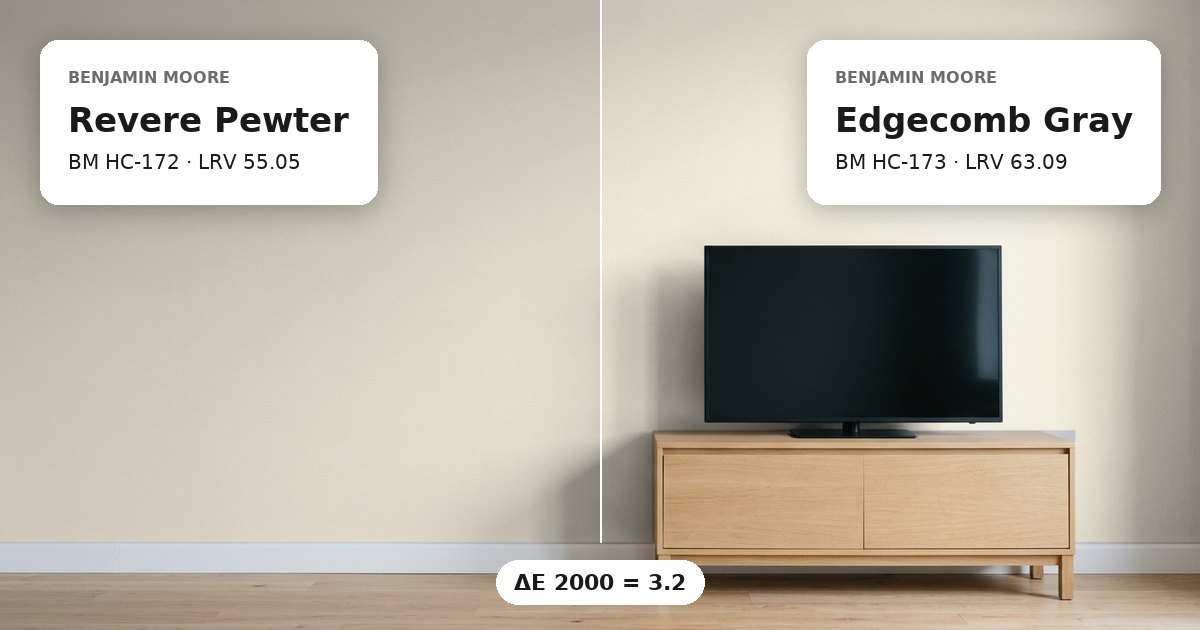
Revere Pewter vs Edgecomb Gray: the measured difference
Revere Pewter vs Edgecomb Gray have a ΔE 2000 of 3.2, placing them in the close but visibly different range when viewed side by side. Both are greiges with warm yellow undertones, so their shared color characteristics help them relate visually. However, their difference is noticeable enough to matter when they cover adjoining walls. Revere Pewter has the deeper appearance, while Edgecomb Gray reflects more light. The contrast comes primarily from their different lightness levels rather than a change in their stated undertone. If you use both colors in connected spaces, expect a visible transition without a dramatic change in the overall color family.
Lightness and depth
Benjamin Moore Revere Pewter (HC-172) has an LRV of 55.05, while Benjamin Moore Edgecomb Gray (HC-173) has an LRV of 63.09. Their LRV difference is 8.04 points. Light reflectance value measures how much visible light a painted surface reflects, with higher values indicating greater reflectance. Therefore, Edgecomb Gray should generally appear brighter than Revere Pewter under comparable lighting conditions. Revere Pewter’s lower LRV gives it more visual depth, whereas Edgecomb Gray sits closer to the lighter end of the greige range. This distinction can influence how each color reads across a large wall or an open-plan interior.
Undertones and where each works
Both colors have warm yellow undertones, which can become more noticeable in some lighting conditions. North-facing rooms typically receive cooler, less direct daylight, so warm undertones may help balance that light. South-facing rooms generally receive stronger, warmer daylight, which can emphasize yellow qualities. Revere Pewter may suit a space where a deeper greige is useful, while Edgecomb Gray offers a lighter alternative for rooms where greater reflectance matters. These are general lighting tendencies, not guarantees; artificial lighting and surrounding finishes also affect appearance.
For adjoining rooms, use Revere Pewter where you want more depth and Edgecomb Gray where a brighter wall color is preferred. White trim can create a clear boundary around either greige, although the perceived contrast depends on the trim’s own color and LRV. If you plan to use both, test large samples on neighboring walls and observe them throughout the day. Keep the lighting and viewing conditions consistent before deciding how the transition looks.
Before you buy, compare a physical sample with the swatch on Benjamin Moore’s page for Revere Pewter and Benjamin Moore’s page for Edgecomb Gray.
Values from each brand's own color page; ΔE and undertone are our calculations. See methodology. Not affiliated with any paint brand.