 Paint Color Lab
Revere Pewter vs Agreeable Gray
Revere Pewter has an LRV of 55.05 versus 60 for Agreeable Gray, a 4.95-point difference; ΔE is 2.5.
Side by side
| Revere Pewter | Agreeable Gray | |
|---|---|---|
| LRV | 55.05 | 60 |
| Undertone | Warm (yellow) | Warm (yellow) |
| Hex | #CBC6B8 | #D1CBC1 |
| Depth | Mid-tone | Light |
Color difference between them: ΔE 2000 = 2.5 (close, visible side by side).
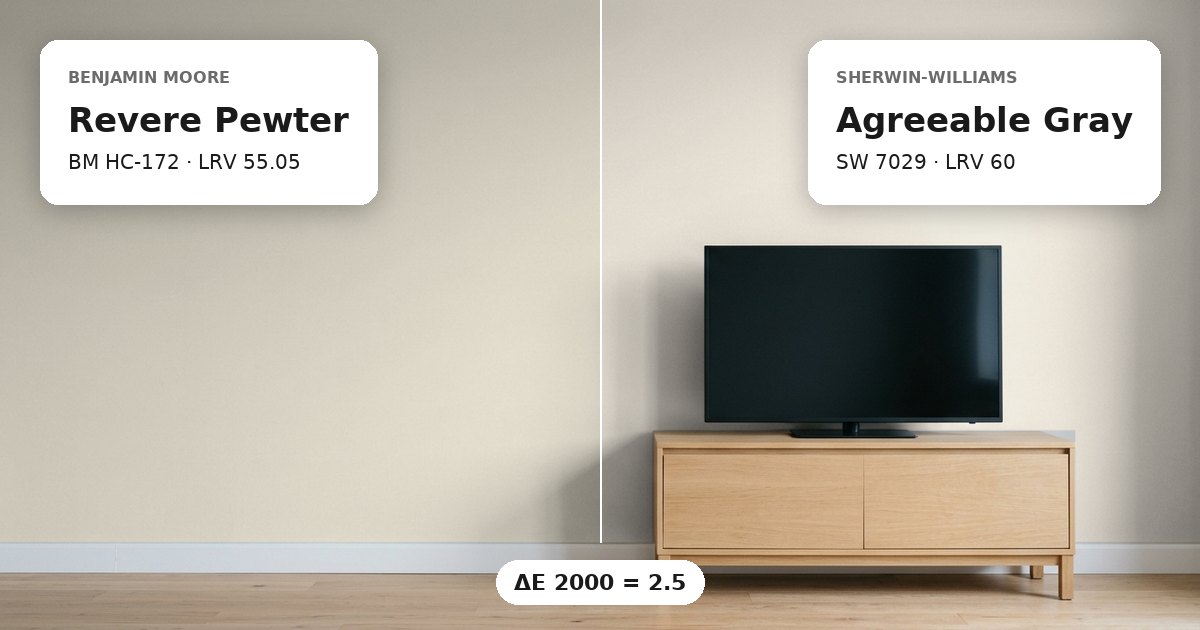
Revere Pewter vs Agreeable Gray: the measured difference
Revere Pewter vs Agreeable Gray have a measured color difference of ΔE 2.5, placing them in the close-but-visible category when compared side by side. Both belong to the greige family and have warm yellow undertones, so their overall direction is similar. However, the supplied hex values show a visible numerical distinction. Benjamin Moore Revere Pewter (HC-172) is #CBC6B8, while Sherwin-Williams Agreeable Gray (SW 7029) is #D1CBC1. Agreeable Gray has the lighter hex value and a higher LRV, while Revere Pewter is the deeper option. On adjoining walls, the difference can establish a restrained transition without changing the basic warm-greige palette. Direct sampling remains important because surrounding colors can affect how clearly the distinction appears.
Lightness and depth
Revere Pewter has an LRV of 55.05, whereas Agreeable Gray has an LRV of 60. The difference is 4.95 points. As a result, Agreeable Gray reflects more light and will generally appear brighter under comparable conditions. Revere Pewter is classified as a mid-tone, while Agreeable Gray is listed as light. That classification difference offers a useful starting point when assigning colors to adjoining rooms. Agreeable Gray may help preserve a brighter wall appearance, while Revere Pewter can provide slightly more visual depth. Still, the final result depends on room orientation, window size, artificial lighting, and nearby finishes. A high-reflectance floor or a bright window can change how both colors appear, so their LRV values should guide rather than replace an in-room comparison.
Undertones and where each works
Both colors have warm yellow undertones, which can help keep a multiroom palette consistent. In north-facing rooms, cooler daylight may make the warmth more apparent, while south-facing light generally adds warmth and can alter the perceived balance. Agreeable Gray is the lighter choice for a wall where greater reflectance is useful. Revere Pewter may work better where a slightly deeper greige helps distinguish an adjoining area. White trim can outline either color, but a trim white with a noticeably different undertone may change the relationship between them. For a connected hallway and living area, compare samples near the doorway as well as on the main walls. Check them beside flooring, cabinets, and trim in both natural and artificial light. If the difference seems too subtle, test the colors at full sample size before committing to a complete paint job.
Before you buy, compare a physical sample with the swatch on Benjamin Moore’s page for Revere Pewter and Sherwin-Williams’s page for Agreeable Gray.
Values from each brand's own color page; ΔE and undertone are our calculations. See methodology. Not affiliated with any paint brand.