 Paint Color Lab
Iron Ore vs Tricorn Black
Iron Ore (LRV 6) is 3 points lighter than Tricorn Black (LRV 3); ΔE 6.8 means the colors are only similar.
Side by side
| Iron Ore | Tricorn Black | |
|---|---|---|
| LRV | 6 | 3 |
| Undertone | Neutral | Neutral |
| Hex | #434341 | #2F2F30 |
| Depth | Dark | Dark |
Color difference between them: ΔE 2000 = 6.8 (similar, clearly different).
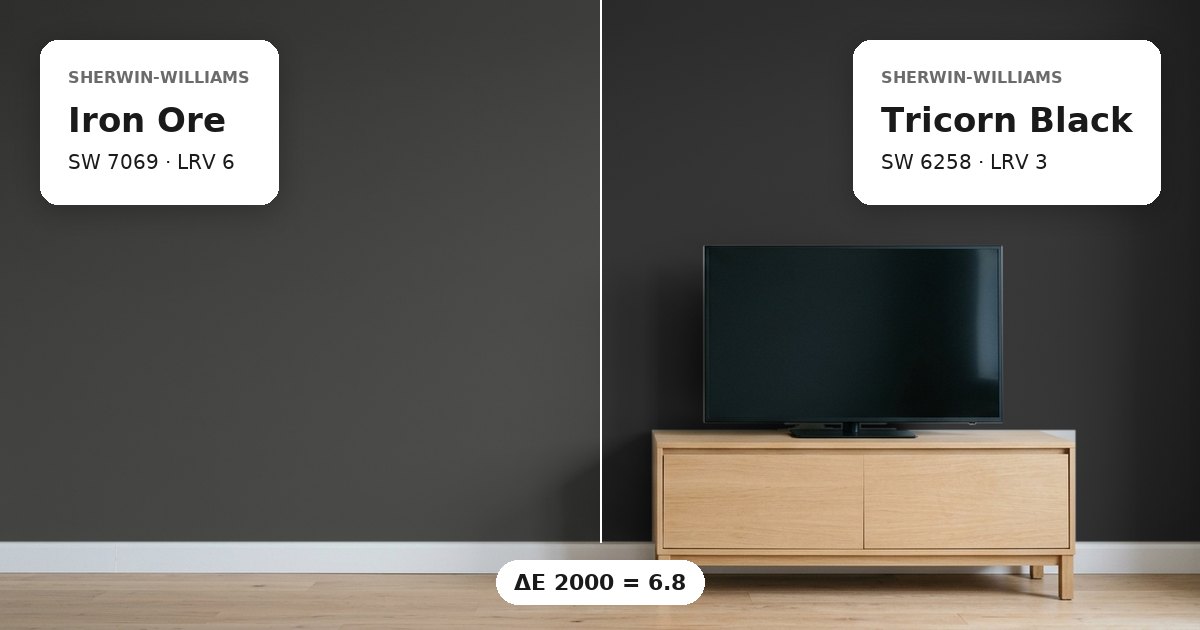
Iron Ore vs Tricorn Black: the measured difference
Sherwin-Williams Iron Ore (SW 7069) vs Tricorn Black (SW 6258) has a ΔE 2000 of 6.8, placing the pair in the only similar category rather than the close-match range. Both paints are classified as dark black colors with neutral undertones. However, their hex values differ: Iron Ore is #434341, while Tricorn Black is #2F2F30. The difference is likely to be noticeable when the colors meet on adjoining walls or appear together on trim, doors, and other painted surfaces. Their shared neutral undertone does not make their appearances identical. Iron Ore’s nearest other-brand match is Black Magic, with a ΔE of 1.9. Tricorn Black’s nearest other-brand match is also Black Magic, but its ΔE is 5.6. These separate values describe the relationship to the other-brand match and should not be confused with the ΔE between the two Sherwin-Williams paints.
Lightness and depth
Iron Ore has an LRV of 6, while Tricorn Black has an LRV of 3. The three-point gap means Iron Ore reflects more light, whereas Tricorn Black reflects less. Under comparable lighting, Iron Ore may therefore appear slightly lighter and less deep. Tricorn Black’s lower value indicates a darker appearance with less reflected light. Both colors remain in the dark range, so neither should be expected to brighten a room in the way a high-LRV paint would. On a large wall, the difference in reflectance can influence how clearly the painted surface reads against lighter surroundings. Artificial lighting, window exposure, and the finish’s sheen can alter the perceived result. Compare samples at the scale and location where the paint will be used before deciding how much contrast is appropriate.
Undertones and where each works
Iron Ore and Tricorn Black both have neutral undertones. This shared characteristic can support a coordinated palette, but their ΔE of 6.8 means they should not be treated as interchangeable blacks. Iron Ore may be the option to test when a dark neutral with slightly more reflected light is needed. Tricorn Black may suit an application where a deeper black appearance is intended. In north-facing rooms, cooler daylight can affect the appearance of nearby colors, while south-facing light often adds warmth. Neutral undertones do not eliminate these environmental effects. For trim and doors, compare the selected black against the wall color and the exact white trim paint. On adjoining walls, use samples side by side to judge whether the visible transition suits the room. Check the colors in daylight and after dark, and keep the sheen consistent during evaluation because reflections can change the apparent depth of a dark finish.
Before you buy, compare a physical sample with the swatch on Sherwin-Williams’s page for Iron Ore and Sherwin-Williams’s page for Tricorn Black.
Values from each brand's own color page; ΔE and undertone are our calculations. See methodology. Not affiliated with any paint brand.