 Paint Color Lab
Hale Navy vs Naval
Hale Navy (LRV 8.36) is lighter than Naval (LRV 4) by 4.36 points; ΔE 5.5 means the colors are only similar.
Side by side
| Hale Navy | Naval | |
|---|---|---|
| LRV | 8.36 | 4 |
| Undertone | Cool (blue) | Cool (blue) |
| Hex | #434B56 | #2F3D4C |
| Depth | Dark | Dark |
Color difference between them: ΔE 2000 = 5.5 (similar, clearly different).
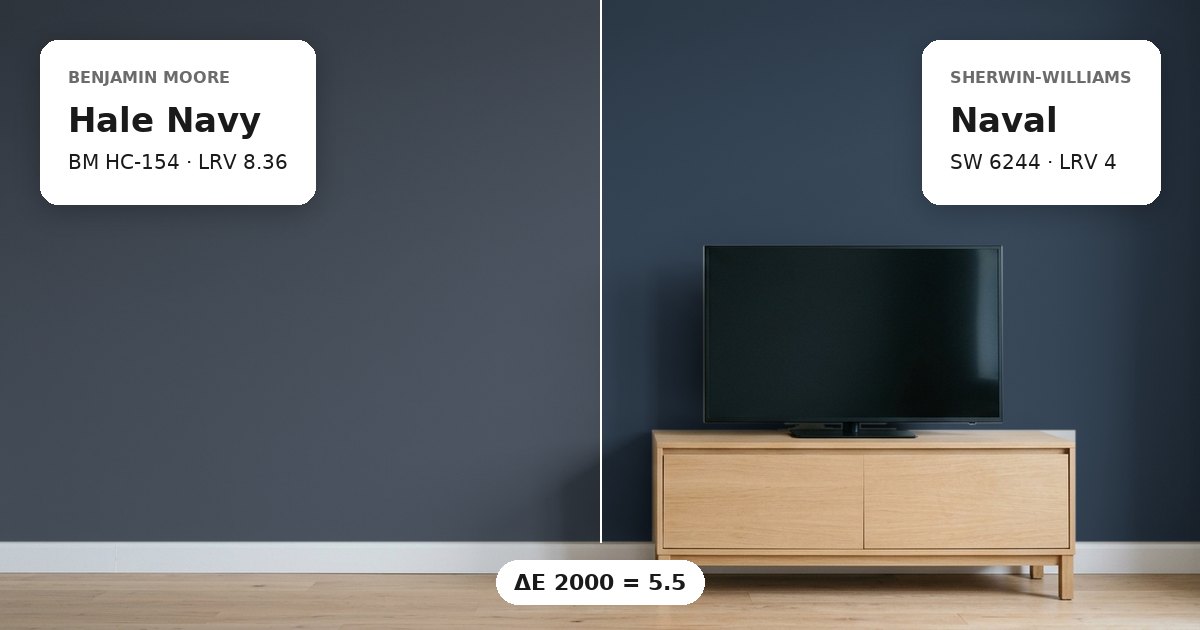
Hale Navy vs Naval: the measured difference
Benjamin Moore Hale Navy (HC-154) vs Sherwin-Williams Naval (SW 6244) has a ΔE 2000 of 5.5, meaning the colors are only similar rather than very close matches. Both are dark blues with cool blue undertones, but their measured difference matters when they appear together. Hale Navy has the hex value #434B56, while Naval is #2F3D4C. These values show that the paints differ in their color composition as well as their overall depth. The contrast may be noticeable on adjoining walls, between connected rooms, or where a wall meets a painted feature. Hale Navy’s nearest other-brand match is Cavalry, with a ΔE of 2.1. Naval’s nearest other-brand match is Gotham Gray, also with a ΔE of 2.1. These are individual cross-brand comparisons, not evidence that Hale Navy and Naval are direct matches.
Lightness and depth
Hale Navy has an LRV of 8.36, while Naval has an LRV of 4. The gap is 4.36 points. Hale Navy has the higher LRV, so it reflects more light and may appear less deep than Naval under comparable conditions. Naval’s lower LRV indicates substantially less reflected light, which can make its dark blue appearance more pronounced. Both colors are classified as dark, but their difference in lightness can still affect a room’s visual balance. Large wall areas painted in a low-LRV color may appear darker when natural light is limited. Before selecting either shade for an entire room, evaluate the available daylight, artificial lighting, and size of the painted surface. The numerical difference offers a useful starting point, but the samples reveal how each paint behaves in the actual space.
Undertones and where each works
Both paints have cool blue undertones, making them options for schemes that use blue as a principal color. Hale Navy’s higher LRV may be worth testing where a dark blue is needed without choosing the lower reflectance of Naval. Naval may suit areas where the intended result can accommodate a deeper finish, provided the room’s lighting supports it. North-facing light often appears cooler and can reinforce cool undertones, while south-facing light generally brings more warmth to a room. These effects should be checked on site rather than assumed. White trim can create a clear light-dark contrast against either navy, but the exact result depends on the trim’s undertone. For adjoining rooms, consider whether the transition between the two blues is intentional, since their ΔE indicates a visible difference. Sample both paints on large boards and view them near the trim, flooring, and doorway. Check the colors throughout the day, and use the intended sheen for a reliable comparison.
Before you buy, compare a physical sample with the swatch on Benjamin Moore’s page for Hale Navy and Sherwin-Williams’s page for Naval.
Values from each brand's own color page; ΔE and undertone are our calculations. See methodology. Not affiliated with any paint brand.