 Paint Color Lab
Greek Villa vs Alabaster
Greek Villa has an LRV of 84 and Alabaster 82, a 2-point difference; ΔE 0.7 means the colors are near-identical.
Side by side
| Greek Villa | Alabaster | |
|---|---|---|
| LRV | 84 | 82 |
| Undertone | Warm (yellow) | Warm (yellow) |
| Hex | #F0ECE2 | #EDEAE0 |
| Depth | Light | Light |
Color difference between them: ΔE 2000 = 0.7 (near-identical).
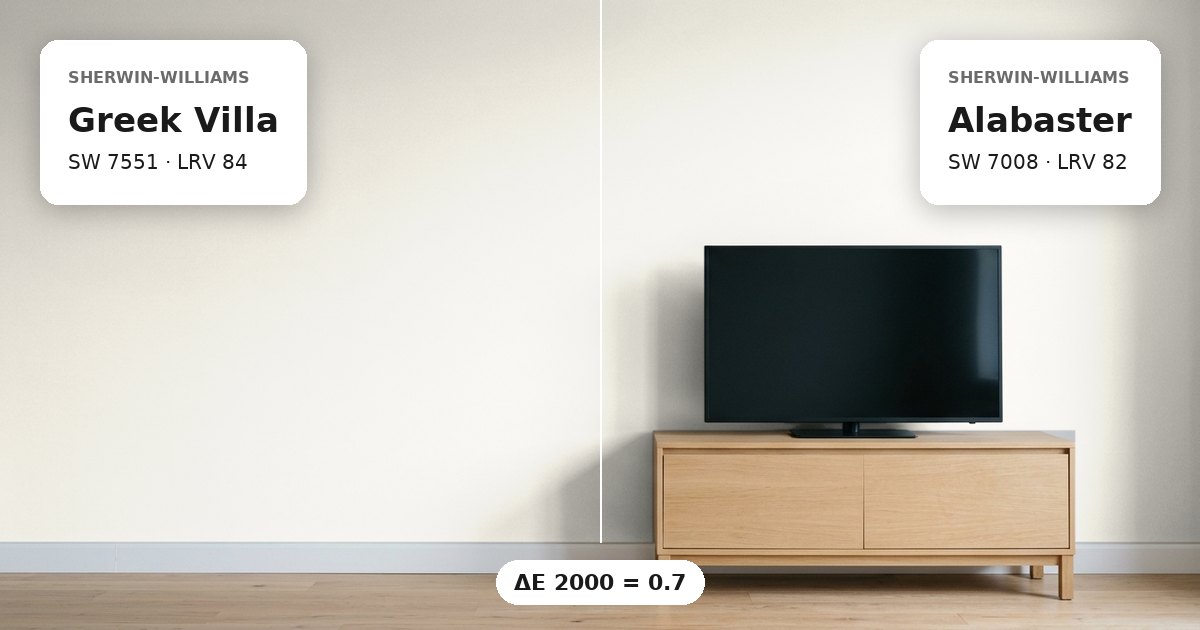
Greek Villa vs Alabaster: the measured difference
Greek Villa vs Alabaster have a ΔE 2000 of 0.7, meaning the two colors are near-identical by this measurement. Both are light whites with warm yellow undertones, and their hex values are close: #F0ECE2 for Greek Villa and #EDEAE0 for Alabaster. On adjoining walls, the difference may be difficult to distinguish under some lighting conditions. However, nearby trim, changes in daylight, or different viewing angles can make small variations more apparent.
The measurement supports treating these shades as closely related options rather than contrasting whites. Greek Villa has an LRV of 84, compared with 82 for Alabaster, so it also has a small numerical brightness advantage. When choosing between them, examine both samples in the actual room. A comparison on separate color cards may not reveal the same differences that appear when large painted areas meet.
Lightness and depth
Greek Villa has an LRV of 84, while Alabaster has an LRV of 82. Their difference is 2 LRV points. Light reflectance value indicates how much visible light a color reflects. A higher LRV generally corresponds to a brighter appearance, making Greek Villa marginally higher in light reflection by the stated figures. Both remain in the light category and have high LRVs, so neither represents a deep or mid-tone wall color.
For a room with limited daylight, the high LRVs indicate that both colors reflect a substantial amount of visible light compared with darker paint options. However, neither number predicts the room’s overall brightness on its own. Window size, room orientation, surrounding surfaces, and artificial lighting all contribute to the result. Use the same sample size and placement for each color, and check them through the day. This helps determine whether the two-point LRV difference is visible in your space.
Undertones and where each works
Greek Villa and Alabaster are both classified as white with warm yellow undertones. Their shared classification and low ΔE support their use as related choices across connected areas. Greek Villa’s nearest other-brand match is Dove White, with a ΔE of 0.6. Alabaster’s nearest other-brand match is Swiss Coffee, with a ΔE of 0.8. These are separate match comparisons, not evidence that the two main colors have different undertone classifications.
For adjoining rooms, either shade can help maintain a consistent warm-white scheme. Greek Villa may be worth testing where the slightly higher LRV is desirable, while Alabaster offers a close alternative with a lower stated value. North-facing light can make warm undertones appear less pronounced, whereas south-facing light may emphasize them. Check both colors beside the chosen trim, flooring, and any other white surfaces. If you use different sheens across walls and woodwork, compare samples in those finishes because sheen changes the way light reflects from the surface.
Before you buy, compare a physical sample with the swatch on Sherwin-Williams’s page for Greek Villa and Sherwin-Williams’s page for Alabaster.
Values from each brand's own color page; ΔE and undertone are our calculations. See methodology. Not affiliated with any paint brand.