 Paint Color Lab
Edgecomb Gray vs Agreeable Gray
Edgecomb Gray (LRV 63.09) is 3.09 points lighter than Agreeable Gray (LRV 60); ΔE 2.9 means they are close but visibly different.
Side by side
| Edgecomb Gray | Agreeable Gray | |
|---|---|---|
| LRV | 63.09 | 60 |
| Undertone | Warm (yellow) | Warm (yellow) |
| Hex | #D9D3C4 | #D1CBC1 |
| Depth | Light | Light |
Color difference between them: ΔE 2000 = 2.9 (close, visible side by side).
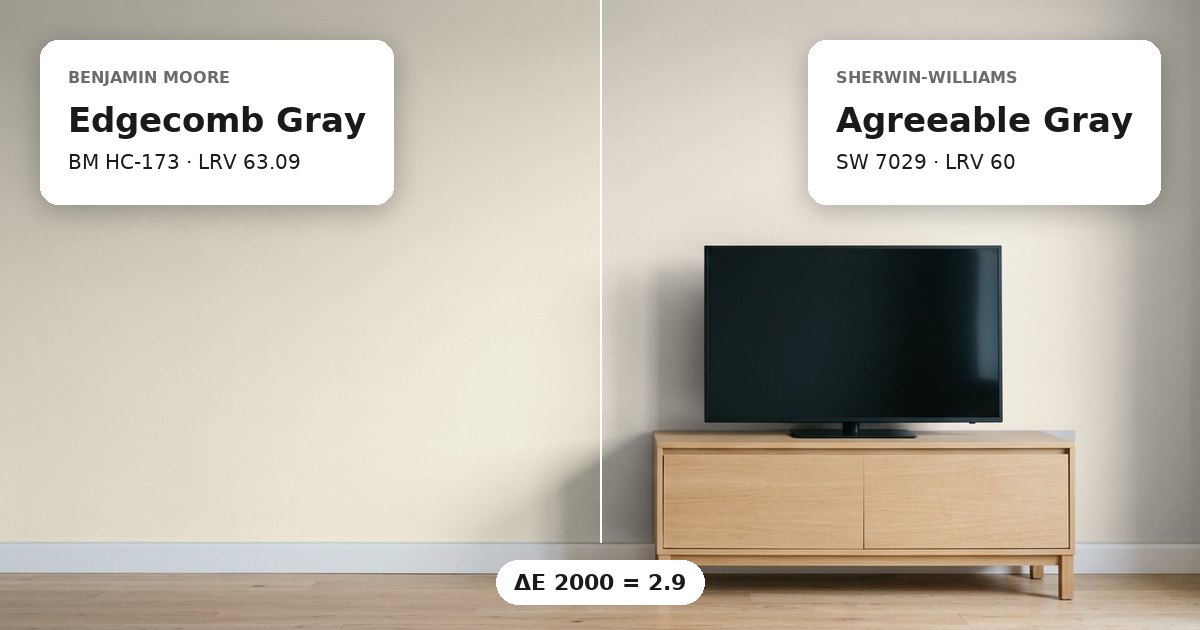
Edgecomb Gray vs Agreeable Gray: the measured difference
Benjamin Moore Edgecomb Gray (HC-173) vs Sherwin-Williams Agreeable Gray (SW 7029) has a ΔE 2000 of 2.9, placing the pair in the close but visible side by side category. Both colors are light greiges with warm yellow undertones. Their shared classification means they occupy a similar broad color family, although the measured difference can become apparent where the walls meet. Edgecomb Gray has the hex value #D9D3C4, while Agreeable Gray is #D1CBC1. These values reflect a difference in color composition rather than a change from warm to cool undertones. Their nearest other-brand matches are Aged Beige for Edgecomb Gray, with a ΔE of 1.3, and Heritage Gray for Agreeable Gray, with a ΔE of 0.0. These match values describe separate comparisons and do not establish that the two paints match each other.
Lightness and depth
Edgecomb Gray has an LRV of 63.09, compared with 60 for Agreeable Gray. The difference is 3.09 LRV points. Edgecomb Gray therefore has the higher light reflectance value and may appear somewhat brighter under comparable conditions. Agreeable Gray has the lower LRV, which indicates slightly less reflected light and potentially a little more visual depth. Both values remain within a relatively light range, so the difference should not be interpreted as a dramatic change from light to dark. Actual appearance depends on room exposure, artificial lighting, and surrounding surfaces. For a connected layout, the higher LRV may be useful when comparing how each color contributes to overall wall brightness. Still, the undertones and measured color difference deserve attention alongside lightness.
Undertones and where each works
Both paints have warm yellow undertones, which can help establish a consistent palette across adjacent spaces. Edgecomb Gray’s higher LRV may make it worth testing in areas where reflected light is a priority. Agreeable Gray provides a slightly lower LRV while remaining in the same light greige category. North-facing daylight can make warm undertones stand out against cooler ambient light, while south-facing daylight often adds warmth to the overall appearance. These effects vary with the room and its surroundings. For trim, compare each greige against the specific white or neutral being considered, because a trim color can appear warmer or cooler by contrast. If using the paints in adjoining rooms, place samples near the connecting doorway and assess both from the same viewing position. Check them against flooring and cabinetry as well. Test in the intended finish, since sheen affects reflections, and review the colors in both daylight and evening lighting before committing.
Before you buy, compare a physical sample with the swatch on Benjamin Moore’s page for Edgecomb Gray and Sherwin-Williams’s page for Agreeable Gray.
Values from each brand's own color page; ΔE and undertone are our calculations. See methodology. Not affiliated with any paint brand.