 Paint Color Lab
Dover White vs Alabaster
Dover White (LRV 83) is 1 point lighter than Alabaster (LRV 82); their ΔE of 1.9 indicates very close colors.
Side by side
| Dover White | Alabaster | |
|---|---|---|
| LRV | 83 | 82 |
| Undertone | Warm (yellow) | Warm (yellow) |
| Hex | #F0EADC | #EDEAE0 |
| Depth | Light | Light |
Color difference between them: ΔE 2000 = 1.9 (very close).
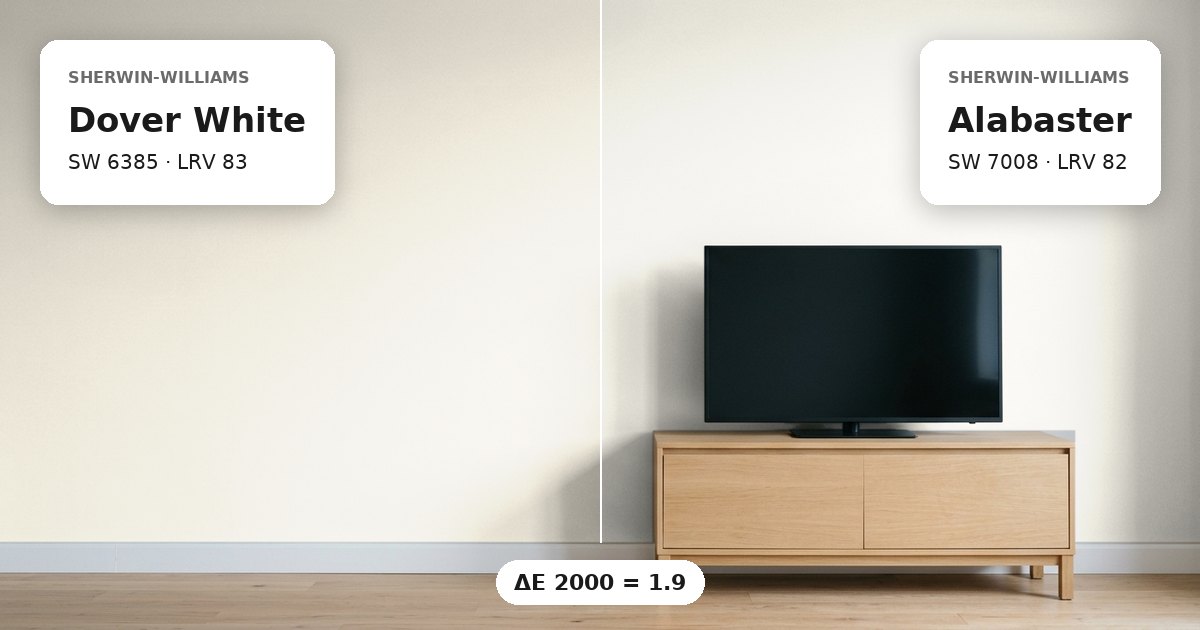
Dover White vs Alabaster: the measured difference
Sherwin-Williams Dover White (SW 6385) vs Alabaster has a ΔE 2000 of 1.9, placing the pair in the very close category. Both paints are light whites with warm yellow undertones, so they share a similar overall color direction. Nevertheless, their differences can still show when the colors meet on adjoining walls or appear side by side around doorways. Dover White has the hex value #F0EADC, while Alabaster is #EDEAE0. These measurements indicate that the colors are close without being identical. The distinction is subtle, so viewing each paint independently may not reveal the full difference. Their nearest other-brand matches are both Swiss Coffee, with a ΔE of 1.1 from Dover White and 0.8 from Alabaster. These separate match measurements do not mean the two Sherwin-Williams colors are interchangeable.
Lightness and depth
Dover White has an LRV of 83, while Alabaster has an LRV of 82. The difference is just one point, indicating nearly identical light-reflecting potential. Dover White has the higher value and may therefore appear marginally brighter under comparable lighting conditions. However, the small LRV gap does not guarantee an obvious brightness difference in every room. Window direction, wall size, nearby colors, and artificial lighting can all influence the result. Both colors fall within the light category, so neither represents a substantial shift toward a darker wall finish. When deciding between them, consider the subtle color difference alongside the lighting conditions and other finishes in the space. A direct sample comparison is more useful than relying on the LRV figures alone.
Undertones and where each works
Dover White and Alabaster both have warm yellow undertones. This shared undertone makes them reasonable candidates for a coordinated palette, but their individual appearances should still guide placement. Dover White has the slightly higher LRV, which may help when a marginal increase in reflected light is desired. Alabaster offers nearly the same lightness with a measurable color distinction. In north-facing rooms, cooler daylight can emphasize the contrast between warm whites and cooler surroundings. South-facing daylight often adds warmth, which may alter how the yellow undertones appear. For adjoining rooms, test both paints on the same wall or on adjacent sample boards so their differences are easy to assess. Check each sample against the proposed trim, flooring, and other nearby finishes. A consistent sheen helps make the color comparison clearer. Observe the samples at different times of day before choosing one for a continuous wall scheme.
Before you buy, compare a physical sample with the swatch on Sherwin-Williams’s page for Dover White and Sherwin-Williams’s page for Alabaster.
Values from each brand's own color page; ΔE and undertone are our calculations. See methodology. Not affiliated with any paint brand.