 Paint Color Lab
Alabaster vs White Dove
Alabaster has an LRV of 82 and White Dove 83.16, a 1.16-point difference; ΔE 1.2 means they are very close.
Side by side
| Alabaster | White Dove | |
|---|---|---|
| LRV | 82 | 83.16 |
| Undertone | Warm (yellow) | Warm (yellow) |
| Hex | #EDEAE0 | #EFEEE5 |
| Depth | Light | Light |
Color difference between them: ΔE 2000 = 1.2 (very close).
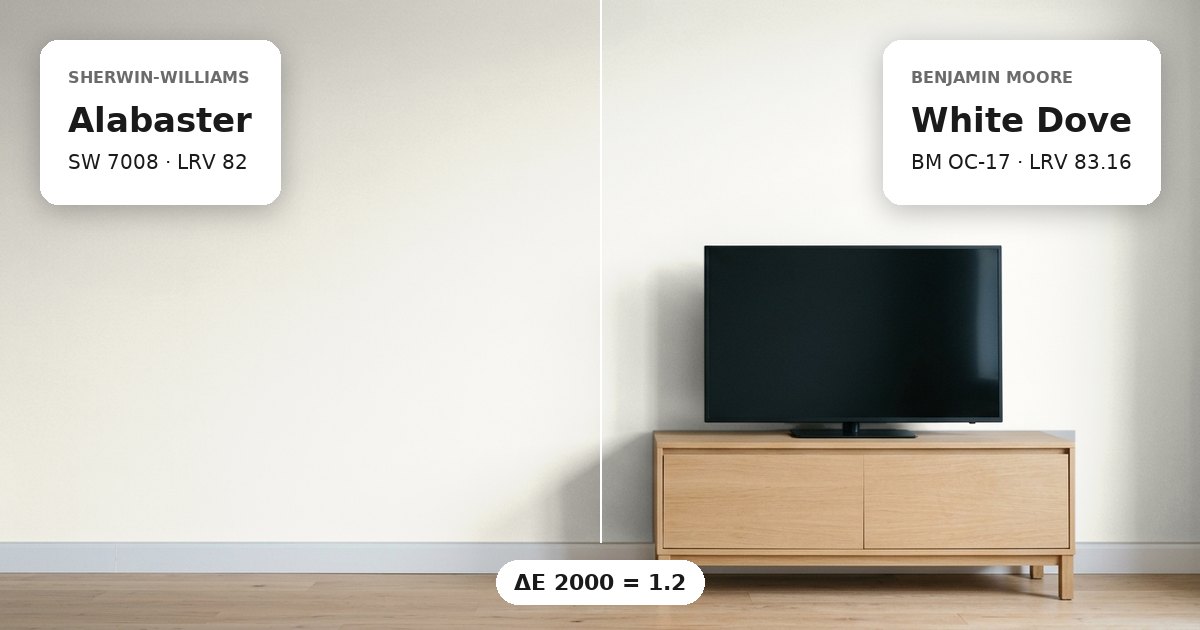
Alabaster vs White Dove: the measured difference
Alabaster vs White Dove have a ΔE 2000 of 1.2, which places them in the very close range. Both are light whites with warm yellow undertones, so their overall color character is similar. However, a close measurement does not mean that the difference will disappear in every setting. When painted on adjoining walls, subtle variations may become easier to notice at corners, doorways, or changes in lighting. Alabaster has a hex value of #EDEAE0, while White Dove has a hex value of #EFEEE5.
The two colors are reasonable candidates for comparison when selecting a warm white for connected spaces. Their small ΔE indicates a close visual relationship, but the final appearance also depends on the room’s light and surrounding finishes. Before choosing between them, place samples beside each other rather than judging them separately. This makes slight differences in brightness and undertone easier to assess under the conditions where the paint will be used.
Lightness and depth
Alabaster has an LRV of 82, while White Dove has an LRV of 83.16. The difference is 1.16 LRV points, with White Dove having the higher value. Light reflectance value measures how much visible light a color reflects, so both paints should generally appear bright. Their small numerical gap suggests only a slight difference in lightness, rather than a strong change in depth.
In practice, either color can be considered for a wall where a light finish is required. White Dove has a marginally higher LRV, while Alabaster sits just below it. Do not rely on the numbers alone to determine which looks brighter in a particular room. Window direction, outdoor conditions, and artificial light can alter the appearance of whites. View large sample patches against the intended ceiling and trim, because nearby white surfaces can make subtle differences more apparent.
Undertones and where each works
Both Alabaster and White Dove are classified as white and have warm yellow undertones. Their similar undertone descriptions support a consistent warm-white approach across adjoining spaces. Their nearest other-brand matches are both listed as Swiss Coffee, with a ΔE of 0.8 for each specified match. These match figures describe the listed comparisons; they do not establish that the paints are interchangeable in every room or finish.
Consider either shade for walls connected by an open doorway, then compare the samples in both spaces before selecting one. North-facing daylight can make warm whites appear less warm, while south-facing daylight often brings out more warmth. Trim in a contrasting white can reveal differences that are less noticeable on separate walls. If you use one color on walls and the other on trim, test the combination at the intended sheen. Differences in sheen affect reflected light, so compare finished samples rather than relying exclusively on small color chips.
Before you buy, compare a physical sample with the swatch on Sherwin-Williams’s page for Alabaster and Benjamin Moore’s page for White Dove.
Values from each brand's own color page; ΔE and undertone are our calculations. See methodology. Not affiliated with any paint brand.