 Paint Color Lab
Alabaster vs Pure White
Alabaster has an LRV of 82 and Pure White 84, a 2-point difference; ΔE 1.9 means they are very close.
Side by side
| Alabaster | Pure White | |
|---|---|---|
| LRV | 82 | 84 |
| Undertone | Warm (yellow) | Subtle warm (yellow) |
| Hex | #EDEAE0 | #EDECE6 |
| Depth | Light | Light |
Color difference between them: ΔE 2000 = 1.9 (very close).
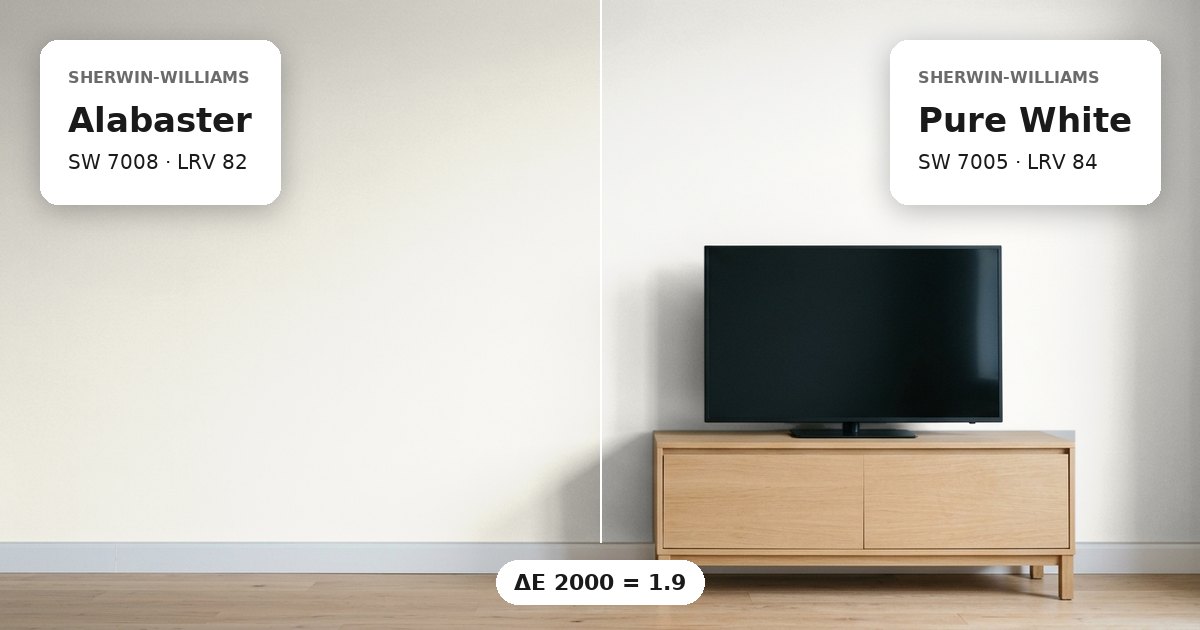
Alabaster vs Pure White: the measured difference
Alabaster vs Pure White compares two light whites with a ΔE 2000 of 1.9. A difference between 1 and 2 means the colors are very close, although careful side-by-side viewing may reveal a distinction. Sherwin-Williams Alabaster (SW 7008) has a hex value of #EDEAE0, while Sherwin-Williams Pure White (SW 7005) has a hex value of #EDECE6. Alabaster has a warm yellow undertone, whereas Pure White has a subtle warm yellow undertone. Their measurements therefore indicate a close comparison, but the undertone descriptions are not identical. On adjoining walls, any contrast is likely to be restrained rather than strong. The colors may appear more distinct under some lighting conditions than others. Use samples in the intended space to check how their undertones and surface appearances compare before assigning each color to a different wall or room.
Lightness and depth
Alabaster has an LRV of 82, compared with 84 for Pure White. The difference is 2 LRV points, so Pure White has slightly higher measured light reflectance. Both values place these colors in the light range. LRV indicates how much visible light a surface reflects, and higher values generally correspond to lighter paint colors. In practical terms, Pure White may appear marginally brighter than Alabaster, although the difference is modest. It does not follow that a room painted Pure White will receive more daylight. Window exposure, artificial lighting, and nearby finishes influence the overall result. If brightness is the deciding factor, place both samples on the same wall and compare them under identical conditions. The LRV figures provide a useful starting point, but the actual visual separation should guide the final choice.
Undertones and where each works
Alabaster has warm yellow undertones, while Pure White is listed with subtle warm yellow undertones. Both can be considered when a room needs a white that does not have a distinctly cool undertone. North-facing light often appears cooler and may make warmth less apparent. South-facing light tends to be warmer and can bring yellow undertones forward. These are general observations, not guaranteed outcomes for every room. For trim, Pure White’s slightly higher LRV may offer some separation from Alabaster walls, but the contrast could remain limited. Check the pair against the trim’s existing color and finish. In adjoining rooms, either shade can maintain a related white palette, while changes in daylight may make their small differences more apparent. Sample the colors near doorways and windows, and view them in both daylight and evening lighting before choosing which should cover the larger area.
Before you buy, compare a physical sample with the swatch on Sherwin-Williams’s page for Alabaster and Sherwin-Williams’s page for Pure White.
Values from each brand's own color page; ΔE and undertone are our calculations. See methodology. Not affiliated with any paint brand.