 Paint Color Lab
Agreeable Gray vs Accessible Beige
Agreeable Gray has an LRV of 60 and Accessible Beige 58, a 2-point difference; ΔE 2.5 indicates close, visible differences.
Side by side
| Agreeable Gray | Accessible Beige | |
|---|---|---|
| LRV | 60 | 58 |
| Undertone | Warm (yellow) | Warm (yellow) |
| Hex | #D1CBC1 | #D1C7B8 |
| Depth | Light | Mid-tone |
Color difference between them: ΔE 2000 = 2.5 (close, visible side by side).
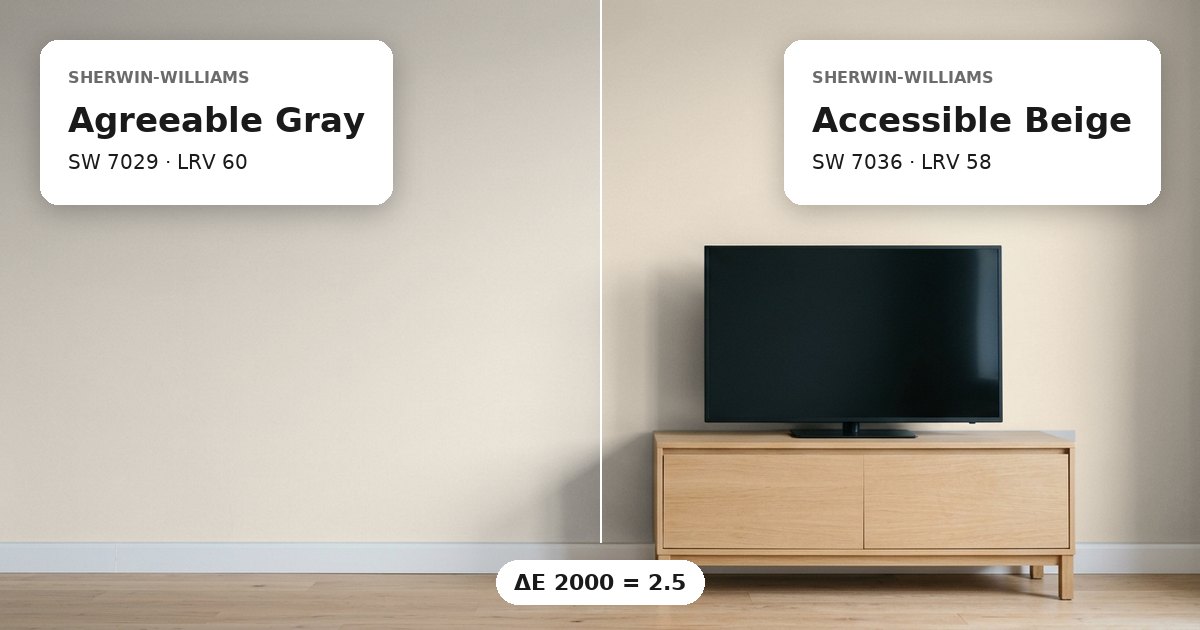
Agreeable Gray vs Accessible Beige: the measured difference
Agreeable Gray vs Accessible Beige have a ΔE 2000 of 2.5, which means they are close but visibly different when placed side by side. Both are greige colors with warm yellow undertones, so their underlying color character is similar. However, their measured difference is noticeable enough to influence how adjoining walls relate to each other. Agreeable Gray has the lighter classification, while Accessible Beige is listed as a mid-tone. Their hex values also differ: #D1CBC1 for Agreeable Gray and #D1C7B8 for Accessible Beige.
When the two colors meet at a corner or doorway, expect a subtle but discernible change rather than a sharp contrast. Agreeable Gray has a slightly cooler-looking gray component in its name, but both colors are specified as having warm yellow undertones. Their shared undertone can help maintain continuity across connected spaces. Nevertheless, test them together before deciding whether the difference is sufficiently visible for your layout.
Lightness and depth
Agreeable Gray has an LRV of 60, while Accessible Beige has an LRV of 58. Their difference is only 2 LRV points. Because a higher light reflectance value generally indicates a brighter paint color, Agreeable Gray has a small numerical advantage in reflected light. Both values sit within a similar range, so the brightness difference should be more restrained than the contrast between colors with widely separated LRVs.
The two shades can therefore serve as related options when planning connected rooms. Agreeable Gray may read marginally lighter, while Accessible Beige may provide a slightly deeper appearance. Actual results depend on the amount and direction of daylight, nearby surfaces, and artificial lighting. For a reliable comparison, place sample patches near the same corner and inspect them in morning, afternoon, and evening light. A small LRV gap does not guarantee that every room will make the colors look identical.
Undertones and where each works
Both paints have warm yellow undertones and are categorized as greige. This shared classification makes their underlying color character compatible, although their hex values show that they are not identical. Agreeable Gray’s hex value is #D1CBC1, and Accessible Beige’s is #D1C7B8. Their nearest other-brand matches are Heritage Gray and Even Better Beige, respectively; each match has its own stated ΔE value, so neither should be treated as an exact substitute based on name alone.
For adjoining rooms, consider Agreeable Gray where a slightly lighter greige is preferred and Accessible Beige where a modestly deeper variation helps define the space. North-facing daylight can reduce the apparent warmth of warm undertones, whereas south-facing daylight can emphasize them. White trim may distinguish both colors from the surrounding woodwork, but the amount of contrast depends on the trim color. Test samples against the intended trim and flooring before committing, especially where a doorway creates a direct comparison between the two wall colors.
Before you buy, compare a physical sample with the swatch on Sherwin-Williams’s page for Agreeable Gray and Sherwin-Williams’s page for Accessible Beige.
Values from each brand's own color page; ΔE and undertone are our calculations. See methodology. Not affiliated with any paint brand.