 Paint Color Lab
Watery Behr HDC-CT-26
Behr Watery (HDC-CT-26) has an LRV of 49 and is closest to Benjamin Moore Smoke (2122-40).
- LRV
- 49light reflectance, 0–100
- Undertone
- Cool (blue)calculated from Lab
- Hex
- #AEBDBB
- RGB
- 174, 189, 187
- CIE Lab
- 75.4 / -5.5 / -0.8D65, from hex
- Depth
- Mid-tone
Closest matches to Watery in other brands
Ranked by CIEDE2000 colour difference (ΔE). Under 1 is near-identical; under 2 is hard to tell apart on a wall.
| Color | Brand | LRV | ΔE 2000 | How close |
|---|---|---|---|---|
| Smoke BM 2122-40 | Benjamin Moore | 56.39 | 3.4 | close, visible side by side |
| Boothbay Gray BM HC-165 | Benjamin Moore | 43.26 | 3.9 | close, visible side by side |
| Blue Arrow Valspar 5001-3C | Valspar | 39.43 | 4.9 | similar, clearly different |
| Comfort Gray SW 6205 | Sherwin-Williams | 54 | 5.1 | similar, clearly different |
| Rainwashed SW 6211 | Sherwin-Williams | 59 | 5.2 | similar, clearly different |
| Granite Dust Valspar 5006-1C | Valspar | 48.11 | 6.2 | similar, clearly different |
| Whirlwind PPG 1013-3 | PPG | 53 | 6.8 | similar, clearly different |
| Flagstone PPG 1001-4 | PPG | 41 | 7.4 | same family only |
Matches come from the 190 colors in our database so far, not from every color each brand makes. Try the color matcher for any hex code.
Watery on a wall
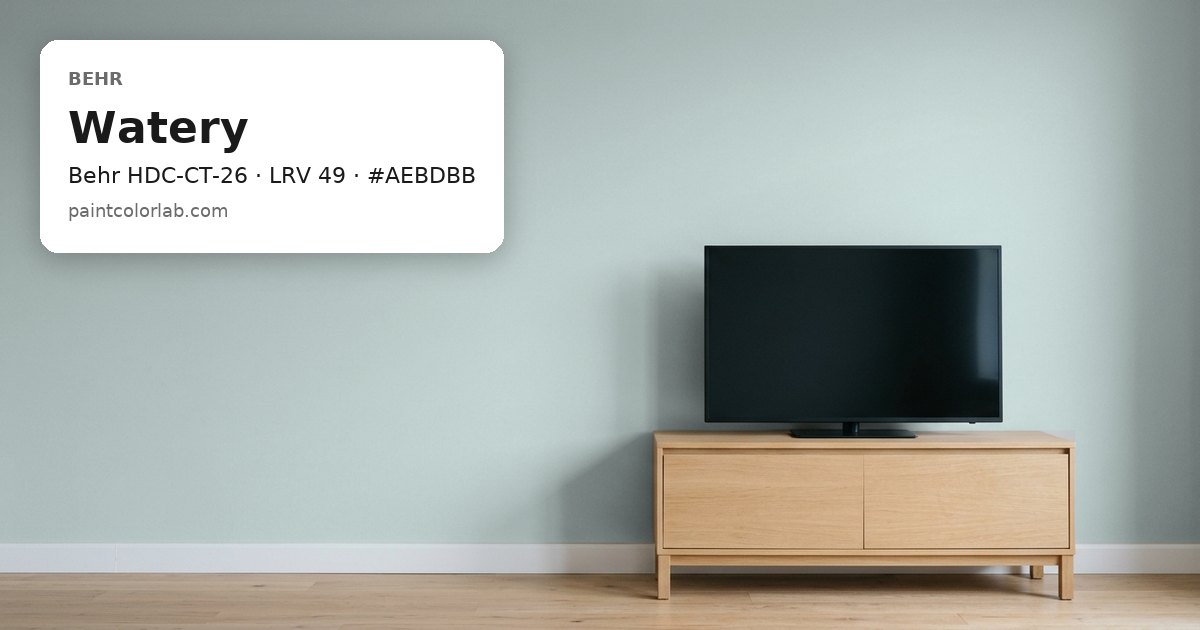
About Watery
Behr Watery (HDC-CT-26) LRV and undertone
Behr Watery (HDC-CT-26) has an LRV of 49, placing it in the mid-tone depth range. Light reflectance value measures how much visible light a painted surface reflects, with higher numbers generally producing a brighter appearance under comparable conditions. Watery belongs to the blue color family and has a calculated cool blue undertone. Its LRV sits between very light colors and darker mid-tones, so the amount of daylight and the size of the painted area will influence how bright it appears. North-facing rooms often receive cooler daylight, which can reinforce cool undertones. South-facing rooms receive warmer light that may shift the perceived balance. Check a sample against flooring, cabinetry, and trim, and assess it at different times of day. The finish also matters because sheen changes how the surface reflects light.
Behr Watery (HDC-CT-26) in other brands
Benjamin Moore Smoke (2122-40), with LRV 56.39 and ΔE 3.4, is a close but visibly different match when viewed beside Watery. Benjamin Moore Boothbay Gray (HC-165), at LRV 43.26 and ΔE 3.9, also falls within the close range. Valspar Blue Arrow (5001-3C), with LRV 39.43 and ΔE 4.9, is only similar rather than close. Sherwin-Williams Comfort Gray (SW 6205), at LRV 54.0 and ΔE 5.1, likewise has a measured difference above 4. ΔE describes color difference using the CIEDE2000 method. Values below 1 indicate near-identical colors, 1 to 2 indicate very close matches, 2 to 4 indicate close but visible differences, and values above 4 indicate only similarity. Compare physical samples before treating a cross-brand alternative as interchangeable.
Lighter and darker Behr alternatives
Behr Breezeway (MQ3-21), with LRV 66, is lighter than Watery and may suit spaces where greater light reflectance is preferred. Behr Light French Gray (720E-2), at LRV 61, is another lighter option. Their ΔE values of 7.5 and 6.2 indicate only general similarity, so the brightness change comes with a noticeable color difference. Behr Jojoba (N390-3), at LRV 47, is slightly darker, while Behr Dolphin Fin (790C-3), at LRV 59, is lighter despite its listed ΔE of 8.7. These comparisons show why LRV and ΔE serve different purposes: one compares reflectance, while the other estimates overall color difference. Use larger samples to evaluate the color in context, especially where cool wall colors meet bright white trim.
Before you buy, compare a physical sample with the swatch on Behr’s page for Watery.
Similar Behr colors
More in Blue paint colors.
Hex, RGB and LRV (as published) from Behr's page for this color, checked October 24, 2026. Lab, undertone and ΔE are our calculations. Not affiliated with Behr. See how we measure colors.